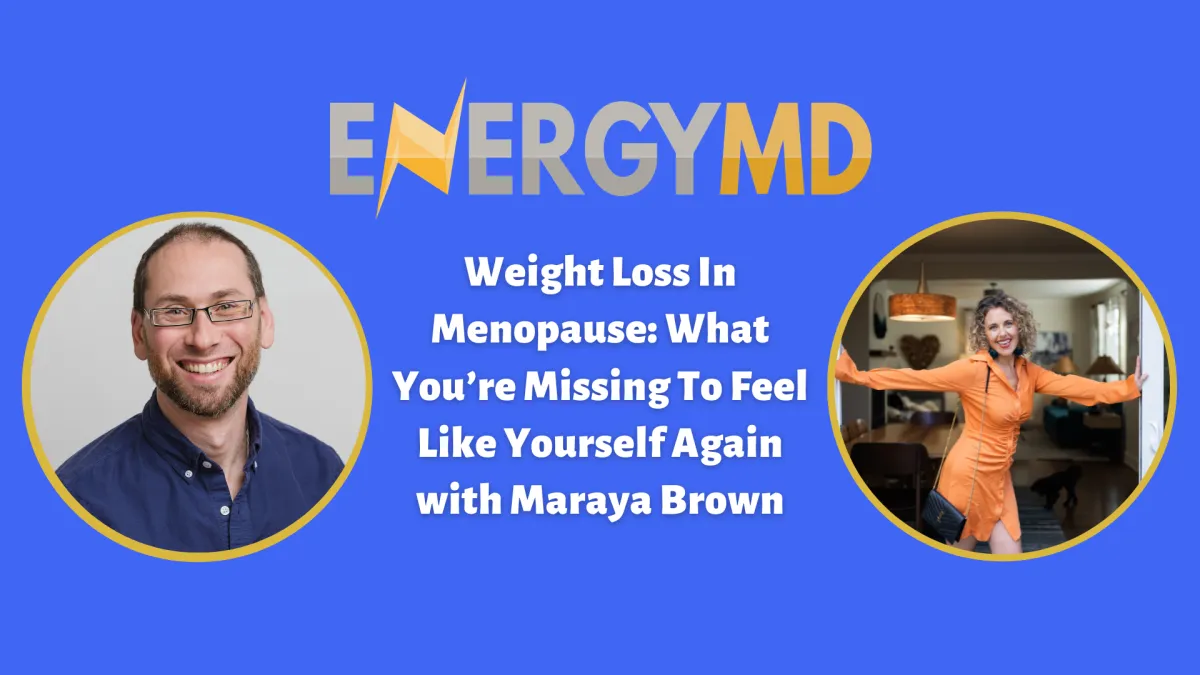
Weight Loss In Menopause: What You’re Missing To Feel Like Yourself Again with Maraya Brown

Weight Loss In Menopause: What You’re Missing To Feel Like Yourself Again with Maraya Brown
00:00
Hey everybody, welcome back to the EnergyMD Podcast, where we help you resolve your long COVID and chronic fatigue syndrome naturally so that you can get back to living your best life. So today I'm really excited because we're going to be talking with Maraya Brown — um — all about perimenopause, menopause, and how oftentimes that becomes a trigger for people
00:26
who end up with long COVID and chronic fatigue syndrome. So let's learn a little bit about her. Maraya Brown is a Yale-trained certified nurse midwife and functional medicine woman's health expert, founder of the Women's Vibrancy Code and host of its globally ranked podcast. She helps ambitious midlife women reclaim their hormones, energy, libido, confidence, and vitality without burning out. With more than 20 years of clinical experience in federally funded clinics, functional medicine,
00:56
and international health work in Nicaragua, Ghana, and Haiti, she now supports women worldwide through online programs, courses, retreats, and her podcast. Maraya blends advanced lab testing, personalized nutrition, nervous system regulation — one of my favorite things — and mindset work to help women create vibrant health and lasting legacy. Maraya, thanks so much for joining me today. Yeah, looking forward to having this conversation. And I know we're doing a podcast swap.
01:24
So I'm also looking forward to learning from you too. Yeah. It's going to be fun. Yeah. So you started off pretty conventional as a certified nurse midwife, right? Or were you always alternative? I think conventional is relative. So I grew up — my father was an entrepreneur and he owned a juice company, kind of like Odwalla, before things had to be pasteurized. So I grew up, you know,
01:53
smelling wheatgrass. She'd, you know, drink shots of wheatgrass as a kid. And my parents were hippies, so there was very little about my upbringing that was conventional. But then I saw — I studied business, went into marketing, and then my best friend from high school asked me to be at her birth in 2000. Of course, I'll be there. And you know, all the stars aligned and the birds chirped in the city and I was like, "Oh, I'm a midwife." And so I
02:23
became a doula, worked at Hollywood Birthing Center, did an around-the-world trip, volunteered with midwives in Ghana, and then was accepted at Yale for my midwifery training. That's pretty conventional. But every summer break and every spring break, I would go study with the mountain midwives in Nicaragua or Hawaii. And, you know, they'd take me out and harvest herbs and tell me how to use them. And I was getting Reiki certified. And so
02:54
yeah, there's like conventional in some ways. It helps to bridge the gap, you know, and like, for me, same thing — my MD provides this base that allows me to explore other things off of it, you know. So I, yeah. Right. Like, I think that there's foundation and understanding physiology. Right. And being familiar with a pharmaceutical approach
03:22
and an approach that's — what's your symptoms, what's your lab, what's your diagnosis, what's your drug — and also, for me, it feels really important to acknowledge that we're mind, body, and spirit. Amen. Yeah, yeah. And so you, at some point, stopped delivering babies and transitioned to just doing the other parts of women's
03:49
um — health. The last birth I attended was 2017. So from 2004 through 2017, I was running the women's health and primary care in a brick-and-mortar clinical setting and attending births. Then 2017, because I became a mom, I had young kids, a breastfeeding baby, you know — I love birth, but I didn't love being on call.
04:19
Me too. Yep. And then 2018 is when I pretty much moved all online except for my retreats. And so that's really honed in on supporting women in perimenopause and menopause. Yeah. Awesome. And so do you operate online as a health coach? Yeah. Yeah, me too. Yeah. Yeah. It gives you a lot of flexibility and you can help people all over the world. And so — who are the main people that you work with right now?
04:49
Yep, most of my clients are ambitious, educated women, predominantly 40 and over — in their 40s and 50s, some in their 60s — that aren't willing to go belly up to status quo. They're tired of providers telling them, "Well, your labs look normal," or "Here's another prescription." And they're wanting a more comprehensive approach. They're all over the world. Right now I have a client in
05:18
everywhere from New Zealand to Switzerland, Canada, the US, everything in between. And then there's the women's retreats, which are in person. Um — but yeah, it's all predominantly women that like to learn, they're educated, they're ambitious. Some stay-at-home moms, but even that demographic, they tend to still — they're dreamers. They're dreamers, yeah, yeah.
05:45
And so what are they struggling with when they come to see you? Yep. Ah — many of them are exhausted. Many of them are having disrupted sleep, pain in their body, menstrual cycle all over the place. I often hear the statement, "I don't recognize myself in the mirror." And they're clear that this experience of, you know, their
06:12
life in their forties and fifties is really kind of getting in the way of their marriage, their relationship, their confidence, their vision-casting, and their ability to function. Yeah. And I mean, I could give a laundry list of all the symptoms, but it's, you know, all the stuff that comes with perimenopause and menopause. Yeah. And so — how much of the work that you do is balancing hormones or optimizing hormones? Yep.
06:41
Because I'm in the health coach category, I'm never prescribing, right? I am ordering labs, so we'll look at functional medicine tests like a Dutch Plus test and a GI map and blood testing, depending on where they are geographically. And so we're looking through the lens of optimizing hormones, but once again, not prescribing,
07:04
in collaboration with their provider, or looking at it through the lens of supplementation, lifestyle, nervous system regulation, nutrition — not just what they do, but who they be as they do. And then I have a team of master coaches. So there's a functional nutritionist, there's a trauma release specialist, I have a sexologist on staff, a mindset coach. And so it's really multidisciplinary. And of
07:33
course, hormonal optimization is at the forefront. Um — but I think sometimes when people hear that, they assume that that means hormone replacement therapy, which it can for some, but it doesn't have to be for everyone. And — I'm not the one prescribing. And also — thyroid optimization. I think that's a big part of it too. Yeah. So — do you have to prescribe hormones in order to get people to optimize their hormones?
08:04
No, no, not at all. I mean, you're an energy MD. Energy goes a long way. Mindset matters. And there are plenty of women that I work with that have no interest in being on hormone replacement therapy or bioidentical hormone replacement therapy. And we still move the needle in a grand way. And we're still able to, quote-unquote, optimize their hormones.
08:32
But those are women that are also willing to change their mindset, their lifestyle, their nutrition. We ended up putting them on personalized supplementation, and we believe that miracles happen. Right. It's not just what you do, but it's who you be as you do. Those aren't just words — it's valid and true. And we all have seen miracles happen. If you believe in prayer, um, you know, I'm not a particularly religious person per se. But that concept
09:02
of —
09:06
— how much we can impact our reality — that just is. Yeah. Awesome. Yeah. And so — you know, what does it look like when people come to see you? Do you have a process that you take them through? How do you do an assessment? What does that look like? Yep. My two main frameworks that I'll support women through — this is so fun, answering all these questions. Loving it. I have what's called the Women's Vibrancy Accelerator Trifecta.
09:36
The trifecta is a 90-day kind of sprint. And in that, we're really looking at a woman's hormones, her thyroid, her adrenals. And so we're able to get in and swiftly create some big impact.
09:51
Um — that's going to be lab testing. Yep. So once again, Dutch Plus test, no matter where they are in the world; depending on geography, we'll add in some blood testing. And then — a support network that includes a group setting. So group Zoom calls, one-on-one time, and also self-paced education. So that, depending on how a woman prefers to learn, she can
10:20
allow the transformation to settle in. And so that can look like nervous system regulation, helping them understand what their adrenals are doing, helping them interpret better labs, and understanding why maybe their thyroid is the problem. But most clinicians, in my opinion, have just been taught to order crap labs and look through crap lenses with crap normal ranges. So helping to shift that lens.
10:50
I think a big part of that is helping women not feel so alone. You know, they get into a container with other women and they go, "Oh my gosh, I'm not the only one." And we're really served by hearing the stories of others, the progress of others. So that's the trifecta — that's 90 days. And then my signature program, which is the Women's Vibrancy Code, is an entire year deep dive. And in that year, they're able — many women will say it's the year that transformed the trajectory of the rest of their lives.
11:22
And so they're held, they're held in community, they're held in — you know — shifting the symptoms like exhaustion and brain fog and insomnia and body aches and pains and all of that. But then there's this point where it's like, "Okay, well, now what?" And that's when the real juicy stuff comes in, and we do in-person work and group work and one-on-one work and more comprehensive testing and
11:51
a really expansive portal for self-paced education. And a woman gets to really start coming alive and looking at her choices and her life and her foundational well-being. It's pretty fun. And then there's always retreats. Just, you know, some women — I just hosted a retreat last week, and a number of those women, it was the first thing that they'd ever experienced with me, and all of them — their lives changed. Yeah.
12:21
Sure. Yeah, fun. It's good work. So then what are the expectations? What can people expect to get out of that trifecta? Um — gosh, these are great. I love all of this. I've got a great site that just has like testimonials upon testimonials, video. So if anybody is really wanting to hear more testimonials and hear from women, you're welcome to reach out to me and the team and we can send it to you if I'm remembering.
12:50
If you just go to my website, you can navigate and find the testimonial tab. But also, if you go to marayabrown.com forward slash replays, there's a lot there. And so — pretty much everyone is going to say things like, "The lights came on. I recognize myself in the mirror again. I have energy. No more bloating and discomfort. The pain in my body is gone. My libido is back on.
13:19
My vagina doesn't hurt anymore. My menstrual cycles aren't so painful." And it's amazing how much we can move the needle in just 90 days. Most of the women then end up enrolling in the year-long program. So, you know, part of me is like, "Just start with the year-long program." But not everybody's ready for that kind of commitment.
13:44
And so it's a nice starting point just to kind of dip our toes and have an experience. That way we feel ready for the broader commitment. Um — depending on what people love and their learning style, you know, if someone is very social, they all love the community. It's very intimate. It's very supportive. For someone that prefers more self-paced, they'll do a deep dive into the portal and geek out on all the stuff and consume it.
14:13
Others just take advantage of the one-on-one time and feel like that's enough. But either way, there's always a container, a holding space for a woman's style of learning and transformation, and also how much time and energy we want to put in. Yeah. Those testimonials at marayabrown.com slash testimonials. Yeah. Let me look. Hold that. I know that marayabrown.com forward slash replays.
14:43
MarayaBrown.com forward slash replays. Let me just go there. Replay without an S. There's a lot of testimonials there. So Maraya, as long as you know how to spell my name — M-A-R-A-Y-A — MarayaBrown.com forward slash replay. If you just go to MarayaBrown.com, my website is currently being rebuilt, so depending on when you're listening to this,
15:10
there is a testimonials tab, and you can always go there, and they're upgrading it, so it's a nice comprehensive mixture of both written and video. But I mean, I'm looking at the tab right now. There's at least 20 different testimonials. And the nice thing with that is all of those women, I didn't give them questions in advance, they're not being paid to share. It's literally just their lives changed and they wanted to share.
15:37
And so I got to ask some questions, and they share what their experience has been. Nice. Yeah. So there's a lot of people doing perimenopause and menopause work out there. What makes you different? Yeah, that's a great question. I think one is track record. You know, I've been supporting women since 2000, so depending on when you're listening to this, for 26 years.
16:05
I have that foundational education from Yale as a nurse practitioner, and clinical experience in federally funded clinics, private practices, functional medicine practices, and online. And so when I say that I work with educated, ambitious women, I'm also a founder and a CEO, and I'm the breadwinner in my home, and I'm a mom of three young children at 49. And so there is an understanding
16:34
and an empathy that's provided when that woman comes in and works with me. I think the other thing that really feels different with my work is — I'm highly intuitive. And so I pick up on energy. And I'm not sure that that's something that can be taught,
17:00
but it's real, and it's potent, and it's powerful. And so for the woman who's educated and she's ambitious — um — often it tends to be a woman who is kind of accustomed to the finer things in life. She often lives a lifestyle where she has a bit of luxury and
17:28
she really wants that level of support in her wellbeing. And so I get that person. I get her very well. And so I think that makes me different. You know, especially during the pandemic, it felt like everybody showed up as a coach, and everywhere you turn around, there's a lot of people specializing in perimenopause and menopause. And I think it's really important for us to vet who we trust
17:57
and really look at a track record and an education. Some other things that, you know, might resonate with listeners and might not — I'm not big on a lot of, um, protocols and calorie counting or macros or weighing food. I just —
18:20
you know, if what you're looking for is a very clear to-do list and a lot of hand-holding, I think there's probably others that are better. I really work with women that wanna cultivate their own intuition. They wanna move into self-trust. And we, as ambitious educated women, we already are juggling a lot every day. And I don't think we need more walls coming in on us, more protocols, more confinement.
18:50
We actually need more expansion. And so I'm generally always going to lead with that. Yeah. Hopefully that helps. So — for a woman who's menopausal, who feels like she's optimized her adrenals, thyroid, she's on sex hormones — uh — she's got an ideal diet, she's exercising, still can't lose weight — yeah.
19:18
Like, what do you do for somebody like that? What else is she struggling with other than weight? Let's say — um — other kinds of inflammation, body pain, joint pain. Yeah. Let's say that they're pretty good on mindset. Maybe they're doing meditation. So they feel like they're doing everything right, but they're still missing something. What do you think they're missing?
19:47
Yeah, I think it's a great question. I don't think there's ever one size that fits all for that particular woman. So the one that we're kind of dissecting a little bit — it's not just that she's not losing the weight, but she also has inflammation in her body. She also has pain in her body. Okay. So we've got to look at what else might be going on.
20:12
Let's make sure that she's had comprehensive thyroid panels. Let's make sure we're looking at gut microbiome testing, maybe a NutraVal to look at heavy metals and nutritional deficiencies. What does her body movement look like? Is she moving her body? Is she sitting at a computer for long periods of time? Is there old trauma that is living in her cells? And when I say that, this is a little woo-woo,
20:42
but I'm going to say it anyway — that old trauma can be from lifetimes ago. And so — um — I love complex cases like that, where a woman says, "I feel like I've tried everything. I've seen the naturopath. I've seen the acupuncturist. I'm on the exercise plan. I have my personal trainer. My diet is impeccable. All my salads are blessed by monks in the Himalayan mountains." Right. And we go, "All right, let's dig in
21:12
and look at what rock has not been unturned." Um — for women in this chapter of life in particular,
21:22
we become more unapologetic, and it's a time where a woman starts looking back at the past decades. What decisions did I make? What decisions did I not make? What unfinished business is unresolved? And I think that — like, the body keeps the score — that can store in the body. If it's honestly just weight, I think sometimes asking a woman
21:52
what does the weight signify for you? So that holding, that gripping tightly of "I have to lose the 10 pounds, I have to lose the 20 pounds" — I think sometimes when a woman allows for some relinquishing of the grip and allowing for more flow, sometimes it can be that simple. And to go, "Oh, well,
22:19
I think that on the other side of losing the weight is going to be more confidence. I think that on the other side of losing the weight is going to be a lover. I think that on the other side of the weight, I'm finally going to be able to wear that bathing suit and take that vacation." And I go, "Okay, well, really?
22:41
Is it really the weight that's going to bring us there, or can we move into identity work and start identifying as her — the woman that looks in the mirror with confidence, the woman that's in Hawaii at the beach in her bathing suit?" And then, ironically, what often happens — what comes first, the chicken or the egg — the weight goes, you know. And then of course there's
23:07
peptide protocols and personalized supplementation. I mentioned gut microbiome. Often they think they've tried all the things. I can think of one guy that I supported. He was working — he lived in Florida. He in that year had seen 23 specialists and he'd been to the ER 13 times. He thought he had tried everything. I had one call with him and I said, "It sounds to me like you have systemic mold."
23:36
So we did a mold test and, lo and behold, there it was. We did a mold detox, and he felt better on the other side. Luckily that was simple. Right. But he thought he had tried all the things. Yeah. Nice. And so — how much of the time is weight gain chronic stress? Great question. A lot of the time, particularly for a woman in perimenopause and menopause who's ambitious.
24:06
We're working hard. We were really good. Yes. We're so good at burning the candle at both ends. Right. So that belly weight is often adrenal weight. I mean, you know, I feel like it's a mixed bag. On one hand, as we start progressing through menopause,
24:26
I think we also need to check our self-judgment at the door. You know, it is a normal process for women to put on a little bit of weight. Breasts tend to get larger, maybe a little bit of belly weight, maybe a little bit more in the hips and butt. And really — is that bad? Now, if it's having health impact, if it's causing pain in the body and it's really troubling, definitely looking at the adrenals
24:56
and the long-standing stress response and constant fight-flight-freeze-fawn for decades, whether it's real, imagined, or anticipated. Once the ovaries start slowing down, it's the adrenals that get the knock on the door. And it's our adrenals that, for the most part, are the things addressing and responding to the stress. So when
25:25
you get the knock on the door and you show up, and you're all disheveled in your robe with a cigarette hanging out your mouth and rollers in your hair — you're like, "What? What are you knocking at my door for?" That's kind of the adrenals, right? They're like, "I'm sorry, I got nothing for you. I'm too tired." So that woman's experience hormonally and with her weight is very different versus a woman that is rested
25:54
and nourished and moving her body and setting clear boundaries and in a pretty stress-free environment — not because what's coming at her isn't stressful, but because she's centered in how she responds to the things that are coming at her. That woman's experience of weight and menopause, in my experience, tends to be very different. Which is — yeah, go ahead.
26:22
Well, how does a woman get to that place of changing her relationship to stress? Well, she comes and works with me. If I had it my way, I'd have you come to a retreat and do virtual work, because it's potent and it's undeniable, the ways in which women are able to really see themselves and see their patterns.
26:51
And — um — I've been taught. Are you familiar with primitive reflex integration? No. Okay. Um — there's a lot of different ways to help our nervous system feel calm, right? Sound baths, breathwork, meditation, EFT or tapping, EMDR — uh — barefoot walking, shinrin-yoku, which is forest bathing. I mean, there's just — it's at our fingertips.
27:21
I'm a big fan of primitive reflex integration. It just makes a lot of sense to me. When we're in the womb and at birth and the first year of life, we have specific reflexes that are intact to survive. Right. So many of us are here with, um, the Moro reflex or the startle reflex. The baby's laying in a crib. There's a loud sound. Its arms and legs go out. Right?
27:50
It makes a sound, calls mom, come to center, and wait. Once that baby can run or walk, the Moro reflex isn't as necessary for survival. So if we use that example, most adults should have their Moro reflex integrated, no longer present. And yet,
28:16
the majority of adults that I've ever tested — that Moro reflex is still intact. We're walking around in a startle reflex because of the onslaught of stress, because of the social media scroll, because of heart coherence and how we pick up on the energy of anyone within 12 to 15 feet of our bodies that we know of. And so it's really striking to see what happens with a woman when she starts
28:45
practicing the primitive reflex integration. Kind of like — if you think about the amygdala. Okay. So if you look at my hand — if I tuck my thumb in, this is the amygdala, your reptilian brain, right? Tucked deep, deep in your brain. 500 million years of evolution. And so what I've been taught, and what I'll say to my kids or I'll say to myself is, "Oh, Mickey's out." What does "Mickey's out" mean? I've had a stress response.
29:14
I'm in some form of fight, flight, freeze, fawn.
29:18
If Mickey is out, that reptilian brain overrides everything else. I'm not moving up to the limbic brain where I can ask myself, "What am I feeling?" or feel motivated. I can't move up to that neocortex where I'm using logic. I'm simply in survival. Okay. What does that mean? I'm thirsty, I'm hungry, I need shelter, I'm safe — and also sexuality — are all in that amygdala space. So now we have
29:48
the majority of humans walking around with our primitive reflexes not fully integrated, which most of the time means our nervous system — 95% of what's actually going on — doesn't feel safe. So Mickey's out. So now we are getting in the way of our ability to ask ourselves, "How does that feel?" or "What do I think?" We're simply in, "Am I safe? Am I safe? Am I safe? Am I safe?"
30:19
Okay. So you brought up the nervous system. You brought up the adrenals. If I'm in fight, flight, freeze, fawn — am I safe? Am I safe? I'm being chased by a lion. The body thinks so, whether it's real, imagined, or anticipated. Immune system is shut off — don't need an immune system if we've got 60 seconds to run fast, fight hard. Digestion is turned off —
30:48
just ate that beautiful salad, you want to absorb the nutrients and digest it well, not important, you've got to run fast. Blood flow to the periphery. Hormone production shut off. Okay. In that context, am I going to be eaten? Of course I want to feel happy and have amazing orgasms and sleep well and, you know, feel motivated. None of that is important if I'm in survival. So
31:19
immune system is shut off, digestion is shut off, hormone production is shut off, and clarity of thought is shut off because we're in survival. What I think most women, like me and my clients, don't realize is — because we're so ambitious, um — because we're highly educated and so good at self-reliance and juggling all the balls at all times, a lot of the time we're operating and Mickey is out.
31:48
The reptilian brain is running the show. So when we can do nervous system work — whatever it is that works for you — you're helping to tuck Mickey in. I like utilizing primitive reflex integration, but I do a lot of different things depending on the client. So now we get to move up to the other parts of the brain where we get to ask ourselves the questions, "How do I feel about this? What do I think about this? What is possible?"
32:16
We also get to turn on the different parts of our brain, both right and left. Anyway, I could talk about that for a long time. That's great. And so — give the listeners and watchers something practical. What's a practical primitive reflex integration technique? Um — good question. I would love to teach you the full series, and I can't do that right now.
32:46
But what I would say is there's two moves that you can do that are, uh, called switching. So they're going to energetically switch you back into the energy source, helping the unconscious mind and the conscious mind turn back on, helping both the right side of your brain and the left side of your brain turn back on. Switching accesses meridian systems.
33:14
So if you're noticing yourself stressed out — maybe it's because you can't think straight, or you're tired, or you're not sleeping well, or you're feeling really irritable and you just bit off somebody's head, and you're running down, really like your nervous system is off — there's two moves that I really like. One is: if you take two fingers — like, let's say your middle finger and thumb — open them wide, find your collarbone on both sides, and go just below the collarbone right in the middle, and you'll feel
33:43
two little divots. Sometimes they're a little tender. And all you do is rub and breathe. You can do this while you're driving, while you're walking down the street, even in a meeting — nobody even knows what you're doing. And if you want, take the other hand and put it on your belly button. Now you're closing the circuit.
34:05
And this is energetic switching. The second one is: if you take a peace sign — make a peace sign with one hand and put, uh, your pointer finger above the top lip and your middle finger below — other hand on your belly to close the circuit, and all you do is rub. It's uncomfortable. This might be a little awkward if you do that in a meeting, but this is doing the same thing. I don't know about you — do you feel it? Well,
34:35
or what do you feel?
34:39
Other than awkward — what? Not much right now. Okay. For me, I can feel from the top of my head down to my entire tailbone — like, everything aligns and I can feel the energy flowing. To breathe.
34:58
Yeah, you can even relax your jaw, relax your lips, and just take note of what you feel in your body. Sometimes I'll even feel like the parts of my brain getting back online.
35:10
So those are two movements you can do at any point. Yeah. Very cool. Do you have a series that you go through with this? Yeah. So — um — I've been in training for two and a half years, and primitive reflex integration actually is not the easiest to get trained in. There's occupational therapists and speech therapists that are often taught this work for children that are diagnosed with ADHD, learning disorders,
35:41
late bedwetting, hard time focusing — so they'll do this, you know, kids on the spectrum. So the first courses I took were specifically targeted for occupational therapists and speech therapists. And then there were some others that I wanted to take, but the teachers — you have to go to Belgium or Australia and do in-person work. They won't do it virtually.
36:08
And it just so happened that I was at a workshop here — I live in Ashland, Oregon — and I was at a workshop here with all the teachers, and I begged and pleaded, "I know this is for children, but I do. I want to learn this too." And I was there and she started doing some of the moves that I was wanting to learn. And I said, "I know what you're doing. How did you learn this?" And she had studied with the same individuals for decades. And she said, "No, you don't have to fly to Belgium. I'll teach you."
36:37
And so I've had the opportunity to study with her. And — um — so the point is there's a lot of different routes to wellness. There's a lot of different routes if what you're struggling with is excess weight or pain in your body or anxiety or irritability, depression, loss of libido — you know, I could go on and on.
37:03
It might be hormones, it might be nutrition, it might be hydration, it might be light pollution, it might be energetics, it might be nervous system, it might be — I mean, I could go on and on and on. So I love the challenge of working with complex individuals that want complex, spectacular lives. Nice.
37:26
And so what is it about this — it sounds like primitive reflex integration is your favorite technique to use for nervous system retraining? It's one of my favorites. It's a little bit more difficult virtually. I tend to use that one when I'm in person with clients or facilitating retreats. Um, but yeah, it's one of my favorites. I also love EFT or tapping. Um, I'm a big fan of adaptogens, making sure women are consuming them.
37:57
Yeah. That's awesome. Yeah. It's really important work. Do you do any work with the nervous system? Yeah. We have a nervous system retraining component to our program. So mindset — so top-down — and then the bottom-up approach utilizing breathwork and vagus stimulation and a number of those things. Yep. I don't facilitate breathwork, but I always bring people in to facilitate breathwork in both the online setting and in person. Yep.
38:26
And sound. I also — the last number of retreats I've brought someone in that does constellation work. Are you familiar with constellation work? Yeah. So powerful. Family constellation. I think. Yes. Yes. Depending on through which lineage. Yeah. I think the point is that there's a lot. There's so many routes. So even whomever is listening, even if you feel like you've tried everything, please don't give up.
38:56
Nice. There's a lot of options. And so then, when you're sitting with somebody, are you utilizing your intuition to determine like which one of these tools is going to be the best for them? Because there's obviously a lot of ways to go. Yeah, absolutely. In an online program, the portal is the portal. The modules are the modules. That's not going to change. And like I said, I have a team of master coaches, so everybody comes in with a different skill set. But yes, for me,
39:27
I'm always going to listen to my intuition. It's always right.
39:33
Sure. Yeah. And once again, a client gets to get quiet with himself or herself and ask herself, "Does this resonate with me? Is this my truth?" I think we all benefit from that. And so when there's so many options, or they're going through the portal, they're doing the retreat — how do they take it home
40:02
so that they can — because obviously these are practices, right? This doesn't happen overnight. So how do you support people in taking it home so that they can do this on a regular basis? Yeah. Well, I mean, we have touchpoints every week in a group setting. There's a group call every week. And then the one-on-one settings — there's some frequency to that.
40:26
And it just happens. I mean, once again, if we spend too much time focusing on strategy, there's always going to be a new strategy to be looking for. But if we focus on strategy and, underneath that, get to the foundation — which is "Who do I be as I implement the strategy?"
40:54
It works, and it settles in, and it becomes embodied or integrated in a totally different way. So women stop chasing the strategy and they start feeling good and being. Does that make sense? So — is there anybody that you can't help?
41:18
Well, there's a difference between can't and don't want to. Absolutely. Yeah. I mean, I already mentioned — if it's someone that's looking for the strategy, the protocol, "Put me on the diet plan, you know, how many macros should I have today?" — that's probably, I'm not the right fit. If it's someone who's going to penny-pinch, they've
41:44
never invested in themselves and they have to squeeze the toothpaste tube down to the very last drop and get every little bit — that tends to not be the right fit for me. If it's someone who has a long track record of blaming and victimhood, you might not know it's you, but if it is, I'm not the right fit for you. I mainly work with women.
42:12
The men that I've worked with have predominantly all been husbands or brothers or friends or uncles of clients. And yeah, and then even children — I've worked with some children or teenagers, but they, once again, have been children or daughters or nieces or nephews of clients. So it generally starts with the woman, or with the woman and her husband.
42:41
So in terms of like the victimhood and whatnot, how do you assess to determine who you let into your program? Yeah, good question. For the trifecta, which is the 90-day — everybody, you can just go to marayabrown.com forward slash trifecta and anybody can enroll in that. In the year-long program, and for the in-person retreats, there is a vetting system. And so, as of right now,
43:09
the team helps to vet the individual, and then I pop on a call with them. So you can call it a breakthrough call or a clarity call. It's making sure that we have a mutual agreement that it feels like a mutual good fit, especially because I'm inviting you into an intimate community and an intimate container. It needs to be a woman that's not coming in with taking energy. Yeah. Really important. Yep. Yep.
43:38
We do those calls as well. You know, it's important to say no and to protect the container. Yep. Yep. And you know, I've had some women get mad at me, but it's like, well, the good news is we both have a podcast that's completely free. I have a YouTube channel that's completely free. And so for the individuals that it really doesn't feel like the right fit, they can always consume that in their own timing and, um, hopefully get a great deal.
44:09
Yeah. Yeah. But it's — you know — I'll say, you can't shop at the dollar menu and expect to feel like a million bucks. Right. And, you know, some women buy a purse at Louis Vuitton and some women buy a purse at Target. Both purses have similar function, but there's also a different energy behind, um, the purchase and, uh, the experience.
44:39
And you're saying something to yourself, to your body, to your nervous system, to your soul when you make an investment in your health. Yeah. Yeah. Often the change starts when they make the purchase, not when they actually pop on the first call, because I mentioned identity work. If I'm going to — like — "OK, my coach — I'm currently enrolled in her year-long program. I paid $50,000 for it. And there's two in-person
45:09
days and then two group calls a month." And what I know to be true is that the change within me started when I said yes. Because it was a declaration to the universe, to God, whatever word works for you, that this is something I desire and I want. And I am the woman who's taking this seriously, and I'm the woman who's going to identify
45:39
as, you know, for me, the version of me on the other side that I'm actually wanting to embody. And so I believe very strongly in the power of that declaration for a woman who says, "I don't have time, but I'm going to find the time because this is a priority. I don't know where the money is going to come from, but I'm going to find it because this is a priority. I'm exhausted,
46:08
but I'm going to find the energy to actually show up because I'm important, and feeling spectacular is important, and I wanna be in this container, and I wanna receive from the full container and also offer myself to the full container." That declaration, and saying yes, is part of the journey. Yeah. Yeah. Wonderful. Yeah. I'm sure you can relate. Indeed. Yeah. Yeah. Yeah, because you're working
46:39
one-on-one and also in group settings? Correct. You're working with individuals that are struggling with a lot of pain. Right. And they're probably exhausted. Indeed. Man, I had eight years — eight years — of pain that was so intense in my neck, I couldn't look up. For eight years.
47:04
If I wanted to look at the stars, I had to hold behind my head. If I wanted to kiss my husband — and I know the emotional labor that that took from me — you know, just that it's like a constant buzzing in the background where I'm, you know, that was when I was running the Women's Health at a federally funded clinic. And then I would take call on the weekends and attend births. And I served greatly,
47:33
but I struggled with pain, and it was exhausting. And it's pretty spectacular to be on the other side of it. Yeah. So when you changed your life — is that when you got rid of the pain?
47:49
Yeah, I tried so many different things. I had two neurosurgeons that told me I needed complete reconstructive surgery on my cervical spine — wow — and that I should just take an ibuprofen every day. And I had a pretty impeccable diet. In my scenario, I cut all gluten out, even though I don't have celiac — I've never been tested to be gluten intolerant.
48:21
I prioritized myself in a different way, and did some beautiful energy work. For the women that are in my year-long container, all receive what's called REST sessions — with two R's. It's called Rapid Reprogramming Emotional Stress Technique. It's just — it's finding the initial event and then changing the pattern. Like shifting the dominoes that have been falling since that initial event. So I did some REST sessions, and
48:50
yeah, I've now been pain-free for 10 years. Yeah. That's amazing. Yeah. So I would — I would say that, you know, what you're offering, or what's different, is that you're not just doing the functional medicine stuff — is that you're also doing a lot of this. Um, it sounds like identity recreation. Um, and not just mindset work, not just nervous system retraining work, but
49:20
uh, but kind of like a really nice combination. Yep. It's a little bit of all of it. It's very multidisciplinary. You know, I think that's another thing. If someone is looking for like, "I want to know the agenda. I want to know what topics are going to be covered on every group call. Show me." — that's probably not the right fit. I really, um, flow. And when I pop on a call, I always have content
49:50
that feels potent and important to bring, but it's also based on the group dynamic and what is real for them and what questions are real for them. So there's a fluidity to it that I believe ambitious women that are accustomed to juggling lots of balls — it serves us. Once again — or maybe I didn't say this, this was a different podcast today — the river: the banks are the masculine, the water is the feminine.
50:20
And both are important. And so we get to allow ourselves to be held. We get to hold at times, but for many of the women that I work with, they're served greatly by allowing themselves to flow and be a bit more like the water. I bet. Yeah. Yeah. That's wonderful. Well, we're at the end of our time together. This has been really amazing. Where do you want to send people?
50:49
MarayaBrown.com. Yeah, as long as you know how to spell my name, right? So it's all A's — M-A-R-A-Y-A — as long as you spell my name correctly, you'll find me. MarayaBrown.com, MarayaBrown on YouTube, MarayaBrown on all the socials, and I'm very approachable — just reach out. And either me or the team will initially respond, and then for many — with most women — I'm happy to hop on a call and explore with you.
51:18
And thanks for listening to this podcast too. Yeah. Yeah. Thank you, guys, all for listening. So if you resonate with what Maraya is talking about today, please reach out. You're worth it. You're worth getting better. You're worth making the investment of the time, the energy, and the money to transform your life, because you do that now, and then you've got another number of decades — 30, 50 years — of really good quality life. So it's definitely worth making that investment.
51:47
Thank you. I really appreciated your questions and your time. So if you have chronic fatigue, whether it's from long COVID or chronic fatigue syndrome, go ahead and click the link below to watch my latest masterclass, where I go deep into our four-step process that has helped thousands of others resolve their symptoms naturally. After you watch that video, if you're interested in seeing if we're a good fit to work together, you can then get on a free call with me.
52:17
All right, thanks so much. I'll see you over there.
52:22
I hope you learned something on today's podcast. If you did, please share it with your friends and family and leave us a five-star review on iTunes. It's really helpful for getting this information out to more people who desperately need it. Sharing all the experts I know and love and the powerful tips I have is one of my absolute favorite things to do. Thanks for being part of my community. Just a reminder, this podcast is for educational purposes only
52:51
and is not a substitute for professional care by a doctor or other qualified medical professional. It is provided with the understanding that it does not constitute medical or other professional advice or services. Thanks for listening, and have an amazing day.