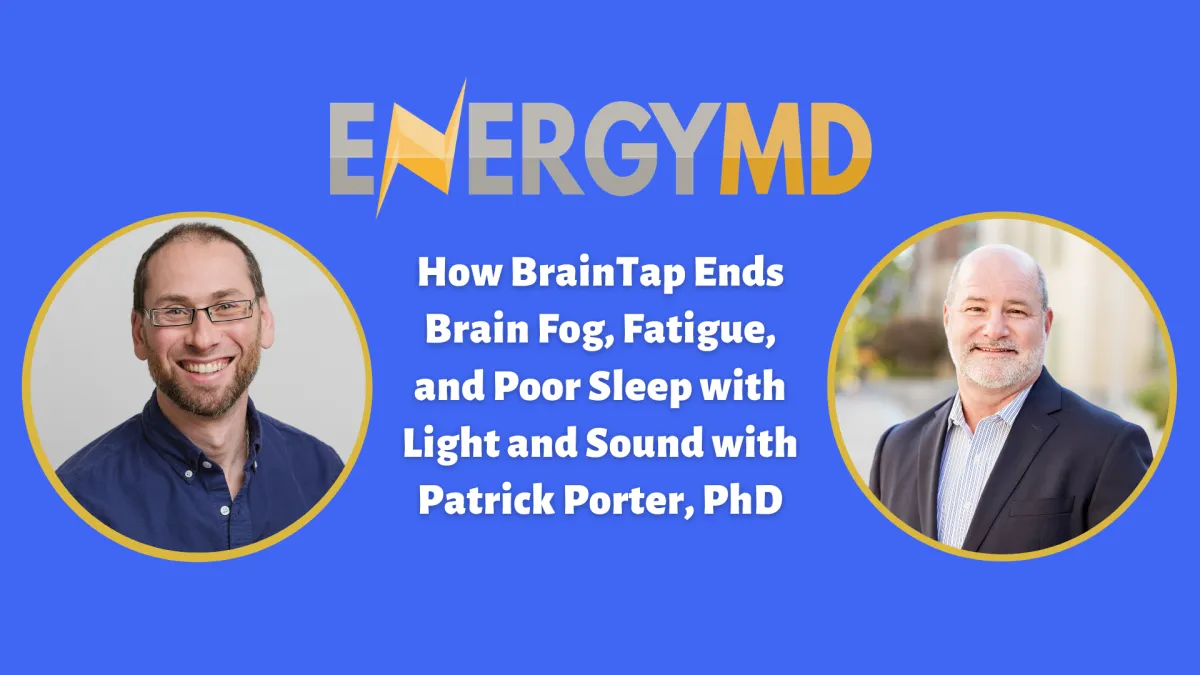
How BrainTap Ends Brain Fog, Fatigue, and Poor Sleep with Light and Sound with Patrick Porter, PhD
How BrainTap Ends Brain Fog, Fatigue, and Poor Sleep with Light and Sound with Patrick Porter, PhD
00:00:00
Hey everybody, welcome back to the EnergyMD Podcast, where we help you resolve your long COVID and chronic fatigue syndrome naturally so that you can get back to living your best life. So, as you know, I talk a lot about the Toxic 5, which is a combination of heavy metals, chemicals, molds, infections, and nervous system dysfunction that really are the root causes of your symptoms. So I'm really excited today because we're going to be talking with the founder of BrainTap, which is a nervous system retraining device.
Let's learn a little bit about him. Dr. Patrick K. Porter is an award-winning author, speaker, and founder of BrainTap, a neuroscience-based platform for optimal brain health and performance. With over three decades pioneering brainwave entrainment technology, he champions non-invasive approaches to mental clarity, emotional resilience, and cognitive longevity. His latest book, Brain Fitness Blueprint, introduces the Circle of Vitality, a holistic model spanning eight wellness dimensions, and explores neuroplasticity and balanced brainwave states. Backed by 30 plus clinical studies and trusted by 120,000 plus users including professional athletes, CEOs, and 3,000 health clinics worldwide, his work has been featured in the Wall Street Journal, CNN, and the Joe Rogan Experience.
00:01:30
Dr. Porter, can I call you Patrick?
00:01:32
Yes, for sure.
00:01:33
Thank you so much for coming on the podcast today. I appreciate you being here.
00:01:40
It's great to be here, Evan. Thank you.
00:01:41
So let's get into the background on why this is important, and then we'll get into the brass tacks around BrainTap specifically. Why is nervous system regulation really the missing link for so many people who feel like they're doing the right thing? They're taking supplements, they're detoxifying, but they still can't overcome their symptoms.
00:02:02
People don't understand that chemistry follows electricity. There's something called the electron transport chain. It all starts with the cells, the mitochondria sending that signal out and getting that electrical charge, the nitric oxide release, and vasodilation. When you're stressed out and your nervous system isn't regulating properly, you can never get into healing mode because your brain is basically in fight or flight the whole time. We call it neurological lock. The body knows how to heal, the brain knows how to heal, but if you're stuck, it's like trying to see the Statue of Liberty in California. You're not in the right state. We've got to get the nervous system into the right state.
00:02:46
I love that. And people listening to this may be thinking, well, you know, I'm not stressed out, or I don't feel stressed out. Just by virtue of having these symptoms, aren't they stressed out or neurologically locked?
00:03:00
If you went through training, you probably learned about those two frogs. They put one frog in a pot of boiling water and it jumped right out. They took another frog, put it in a pot of tepid water, got it boiling, and he's doing the backstroke thinking he's having a great life, and the next thing you know, he's boiled alive. People don't realize this because it's a physiological thing. We call it a neurological norm. They think it's normal to be stressed.
Stress isn't the problem. I need your listeners to know that. It's recovery that's the problem. We can handle a great deal of stress. Think about the professional athlete who pushes their body to the limits, to the breaking point actually. But they recover. Tom Brady is one of our biggest advocates because he says for every one minute of exertion, you need two minutes of recovery. Most people don't realize that they get up in the morning, hit the ground running, and they're part of the human race. I say a race, like we're at the hundred-yard line, we look down the track, and go, wait a minute, I didn't sign up for this. And they go, well, you didn't train for it. You really need to train for the life you want to live. You can't just expect your body to perform when you've never trained it.
00:04:11
Train for the life you want to live. That is very powerful. I love that. So with that boiling pot analogy, it's about the fact that we can adapt and accommodate stressors. And then all of a sudden, at some point, our body is like, enough is enough. Is that accurate?
00:04:33
Yes, and that's why Heart Rate Variability, or HRV, has become such a gold standard in looking at the nervous system. Our heart regulates most of the nervous system. It's like the orchestra leader. The brain between our ears is the energizer, but if we're not coherent, which means we don't have that harmonics going on, the communication between the heart-brain connection and the gut-brain connection, then it doesn't matter what supplement you're taking. People try to supplement themselves out of electrical problems. What they find is once you get your brain right, everything else seems to work better because it's the master controller of everything.
00:05:15
With the HRV you're referring to, is that something that BrainTap measures?
00:05:22
Yes, we actually have a device called Neural Check because we measure 27 parameters of the nervous system. In one of our studies with the NIH, we took non-meditating women aged 55 to 65 and improved their nervous system function by 30% in a single 20-minute session. We then proved that if they did it three times a week, they maintained it.
The nervous system wants to reset every 72 hours. The nervous system you have today was actually started three days ago. That's why when we work out, they say to do it every other day. Muscles have a 72-hour window for replenishment. We need to stress the body, recover, and stress the body again. With two-thirds of the world not sleeping, people don't realize the most neurological activity happens when you sleep. Sleep isn't a luxury, it's a necessity. That's when your brain does most of its healing and sets your body up for the next day.
00:06:34
So is that the recovery time that we need? You had that quote where Tom Brady said for every one minute of exertion, you need two minutes of recovery. Is sleep enough?
00:06:45
Sleep isn't enough because of the life we're living. If we went back in time ten thousand years, we would work until two p.m. maybe. We're the only culture since the Industrial Revolution working past two p.m. At two p.m., our body has a neurological reset. We drop in temperature two degrees due to the circadian rhythm. If we're not in bed by ten p.m., we don't make as much melatonin. If we're not in bed by eleven p.m., we don't clean our liver. All these things happen because the sun is beaming codes to our body.
In a 1992 symposium, medical doctors looked at the body more as a Wi-Fi network than a chemical or biological system. Cell signaling is a big thing out there right now. The reality is that we are designed to heal, but what happens is we get a pattern and the brain says, this is the easiest pattern, I did it yesterday, I'll do it again. I don't call them habits, I call them rituals. People have rituals they do every day, and some of those rituals are actually killing them. For instance, people were told fat makes you fat, so everyone stopped eating fat. We now know essential fats are necessary for the brain. Taking one tablespoon of really good olive oil drops your chances of dementia by 40%. The brain needs that fat. But people are still following low-fat diets.
00:08:57
So what do you think a natural work rhythm should be? What time should we start work, what time should we end work? Is that why the siesta is around that time?
00:09:07
Exactly. And why the Queen has tea time. She gets tired, she says, let's caffeinate. My pet peeve is this: I don't think you should drink coffee first thing in the morning because I've seen it in the lab. The minute you drink a cup of coffee, you crush the cortisol curve. We need cortisol, dopamine, and norepinephrine to get up in the morning. If you wake up nervous, it's different than yesterday. But people drag themselves from yesterday into today using coffee.
We need to wake up with a large glass of clean water with mineralized salts, because our brain shrinks three-quarters of an inch during sleep. This happens naturally to detox. If you were in medical school in 2015, you didn't learn about the lymphatic system above the neck. In a sleep study in Denmark, they found this system opens up during level four sleep. The brain, skull, and cells respirate.
I believe in the morning you should wake up, not have coffee for two hours, and do your workout. You shouldn't need coffee if you had a good night's sleep. Sleep longevity studies show six and a half hours is optimal, but you must have one hour of deep sleep and two hours of REM sleep. That detoxes the brain and reorganizes your thoughts for neuroplasticity.
00:12:00
We did a study with Google and Microsoft wellness programs. Programmers were getting burned out. I told them to take a 20-minute BrainTap session at two p.m. The group that did BrainTap for four weeks actually did 26% more work because their brains were more efficient and made fewer mistakes. At two p.m., we rebuild that cortisol curve, recycling you through a sleep cycle in 20 minutes so you're ready for the rest of the day.
00:13:14
Many companies use escape rooms for employees who are too stressed. One thing common to all negative emotional states, anger, fear, frustration, depression, is a lack of breathing. Your breath helps unlock the nervous system. With the average person looking at their phone 300 times a day, if you look at life as a threat, you down-regulate every DNA pair in your body. MIT just released a study showing every DNA pair rebraids every 40 seconds. Your body is constantly in flux. If you look at life as a threat, it down-regulates. If you look at it as a challenge, the epigenetic markers go positive.
00:15:46
If we take caffeine out of the equation, what time should we wake up and start working, and should we stop working at two p.m.?
00:16:00
The earlier the better. Farmers get up early to do heavy work, take a nap, and have their biggest meal in the middle of the day. But now we're in offices working. Sitting is the new smoking. If I just sit for an hour, my nervous system down-regulates. Motion is lotion for the body. Smokers used to be in better health during some crises because they'd actually get up, walk outside, and take a break.
You can use a timer on your computer. Just getting up, doing deep knee bends, and breathing is enough to reset your nervous system.
00:17:51
I'm standing right now, and if you have music playing, you can dance to it.
00:18:00
Yes. We've found that people who dance, do yoga, or Tai Chi always test the best with nervous system function. Our bodies are designed to move. In our dementia studies, we took everyone off the dementia scale in less than six weeks because it's about energy.
When you were born, you were 18.1 volts. Your brain was lit up. By the time you're 21, it's about 10.1 volts. If that voltage drops below seven, you'll start having symptoms of dementia. If it drops below four, you'll have symptoms of Alzheimer's. The nice thing is, if you clear out the toxins and trauma, your mitochondria act like a smoldering fire. If you put wet leaves on a fire, it smolders. Clear out the leaves, give it oxygen, and the fire burns bright again.
00:19:48
Let's get into the technology. You utilize light, sound, and frequency. How does that impact mitochondrial health and increase ATP?
00:23:24
Every cell in your body has a chromophore on it. It's like a little battery that is always gaining or losing energy. When you hear music you like, you gain energy. The cells absorb the sound vibration, convert it into electrical energy, and the mitochondria share it via photobiomodulation.
We use 470 nanometer, 650 nanometer, and 810 nanometer light. The cells literally eat that light up. Because hemoglobin circulates through the ears every three to five minutes, we deliver light through the ears and the eyes. This energy starts the Krebs cycle, produces nitric oxide, and causes vasodilation.
00:25:58
The problem is we're mostly indoors. We need to share electrons with the Earth. If you have three volts of dirty energy coursing through you from Wi-Fi and screens, you need to ground yourself. If you use a voltmeter while wearing plastic shoes, you'll see you carry a charge. Take your shoes off outside, and it drops to zero. The body is designed to ground that energy into the Earth.
00:27:58
With BrainTap, we balance the hemispheres of the brain using a science called frequency-following response. The brain will synchronize to the frequencies we play. The Earth resonates at 7.8 hertz, which is alpha. When we go to the forest, we synchronize with it. In 1986, we used flickering candles, which flicker at 10 hertz, also alpha, to mesmerize people and create acetylcholine.
00:30:00
The brain is always asking, am I safe? If you're stuck in high alert, the brain runs the wrong frequencies. In the morning, people often lack SMR, sensory motor rhythm, which sits between beta and alpha. You need it for creativity and language.
00:31:00
We have over 3,000 protocols. Do a 10-minute session in the morning. At night, we do delta training for deep sleep. The brain learns and adapts. The Mozart effect makes you smarter while the music plays, but BrainTap's algorithmic training creates neuroplasticity that lasts for 72 hours.
00:33:23
How long does it take to see results? Do you need to use BrainTap forever?
00:33:37
You don't have to use it forever. If you live on a deserted island with no stress, you don't need it. But with modern stress, using it once a week maintains it. Our average user uses it 27 times a month.
00:34:55
There's something called neuropruning. The brain prunes unused connections. We are constantly building new neurons, but if you don't do activities that maintain them, your brain slowly disconnects.
00:35:33
For symptom improvement with chronic fatigue or Long COVID, how long does it take?
00:35:46
90% of people will start sleeping well the first night. We did a study with Australian coal miners who were only getting one minute of deep sleep a night. Within three weeks of using BrainTap, they were sleeping better than 70% of Americans.
00:37:25
People who can't sleep are dealing with energy vampires. When you're stressed, the liver dumps sugar into the bloodstream. You get insulin resistance, and your body stores fat. We need to liberate fat from cells for energy. BrainTap gives you energy by unlocking the nervous system and liberating that fat.
00:39:00
We also act as a vagus nerve stimulator. Humming works just as well to stimulate the vagus nerve. Humming while doing BrainTap changes vagal tone significantly because the light stimulates the cranial nerves in the ears.
00:40:55
When you close your eyes to meditate normally, 30% of your brain goes dormant. Blood flow goes to the amygdala, and the monkey mind takes over. By flashing lights on the retina, we keep the frontal lobe awake so you can actually process and heal rather than just triggering fight-or-flight memories.
00:43:00
Thoughts are frequencies. We demonstrated this with a potato crystal radio. If you think positive thoughts, your body resonates positively.
00:44:30
Kids today have eye shape changes from looking at screens too closely. They need to look at distances. Constantly looking at screens is a massive stressor.
00:46:00
How does BrainTap compare to limbic system retraining programs like Gupta or Primal Trust?
00:46:30
Those are all good programs. What happens when you use BrainTap is you disassociate from the problem. The number one rule in psychology is you can't be a behavior. People say, I'm an alcoholic. No, your body just can't process alcohol. You have to realize you have internal resources. You use timeline therapy. When you solve a problem, it creates a vacuum in the brain. Nature hates a void. You have to fill that void with a superpower or a positive vision of the future, otherwise the old trauma rushes back in.
00:48:58
That's why AA is only about 2% successful long-term. They keep talking about the problem. You don't solve a problem by continually focusing on it. You solve it by creating a new solution.
00:49:25
We did a concussion study in Michigan. Patients were 30% to 70% neurologically better after one year just from retraining the brain. We work with veterans with PTSD, getting them back to their lives successfully.
00:51:30
As for heavy metals and toxins, the body keeps score. Change the mechanism of the mind, and the physical body follows.
00:53:00
The NIH proved in 1994 that every living being has a three-foot biomagnetic field. All illness starts in that field. But doctors are still giving pills instead of treating the biofield. We have to clear out the environment and the toxins.
00:54:00
Just a couple of minutes left. Tell us about your book, Brain Fitness Blueprint, and BrainTap.
00:54:17
You can get the book Brain Fitness Blueprint on our website or Amazon. For BrainTap, go to braintap.com. Start the 14-day free trial on the app. Don't invest in the headset until you try the app and know you like the content. We have a very low return rate on the headsets because we want people to experience the value first. If they like the app, the headset makes the experience exponentially better.
00:55:36
I could talk to you all day. You're doing the light, the sound, and the brain retraining all in one. It's brilliant. Thank you so much for coming on today, Patrick. I really appreciate you.
00:56:22
Thanks for having me.
00:56:26
If you have chronic fatigue from Long COVID or chronic fatigue syndrome, go ahead and click the link below to watch my latest masterclass, where I go deep into our four-step process that has helped thousands resolve their symptoms naturally. After you watch that video, if you're interested in seeing if we're a good fit to work together, you can get on a free call with me. Thanks so much. I hope you learned something on today's podcast. Please share it with your friends and family and leave us a five-star review on iTunes. Sharing the experts I know and love is one of my absolute favorite things to do. Have an amazing day.