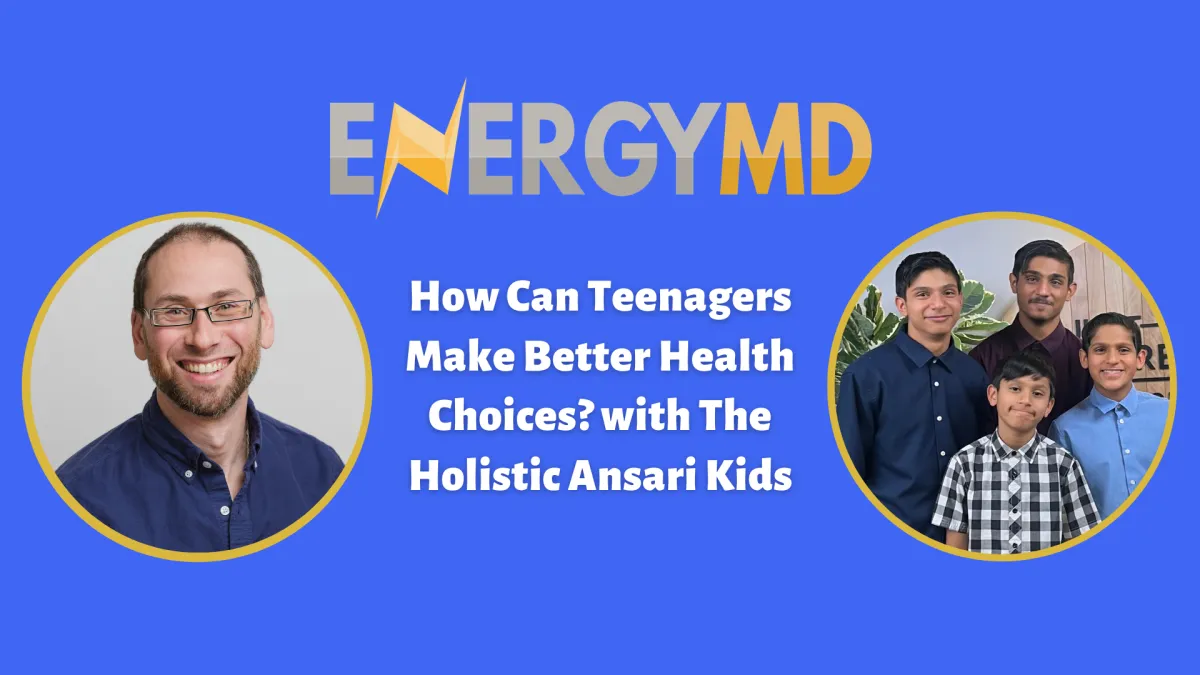
How Can Teenagers Make Better Health Choices? with The Holistic Ansari Kids

How Can Teenagers Make Better Health Choices? with The Holistic Ansari Kids
00:00
Hey everybody. Welcome back to the EnergyMD podcast, where we help you resolve your Long COVID and chronic fatigue syndrome naturally. So if you have kids, if you have teenagers, and you're wondering what are some of the optimal lifestyle habits they should have — habits that would help them improve their energy, their mood, their overall health — stay tuned, because we're going to be talking
00:28
with a couple of new friends of mine. So let's learn a little bit about them. This is the Ansari family. And today we have Zain, Emaad, and Qasim Ansari. They're the hosts of the Holistic Kids Show and co-authors of the bestselling book, The Teen Health Revolution: Lifestyle Secrets to Optimize Your Mind, Body and Soul. The kid-run podcast features 200+ episodes with New York Times bestselling authors, Harvard professors,
00:58
top physicians, and national media voices, ranking in the top 2% of podcasts globally. As the first youth speakers at major integrative medicine conferences, including IFM in 2024 and a forum in 2025, they earned the 2025 Up and Comer Award. Media appearances include NBC, CBS, TEDx, and TED-Ed. Gentlemen, thank you so much for joining me here today.
01:27
It is our pleasure. It really is our pleasure. We are so thankful for being here today. Awesome. So let's kind of dive in here. What made you guys get into this and write your book? Did you guys have any health issues you were dealing with? What's your story? I mean, we were raised in a family — and the extended family — that were all in medicine. Our grandparents, our aunts, our uncles were all in medicine.
01:57
And so were our parents. But when we were sick, no one really knew what was going on. So I think it's really important to know that the conventional system wasn't teaching things that we needed to know for our health. And when we were diving deeper into this, we started learning a lot about functional medicine and how lifestyle is really important for our health. And that's why we...
02:26
We really started diving deep into this. Then we started our own podcast so we could teach other kids about this and learn from amazing experts like you. We had you on our podcast. That's right. And of course, while Zain was talking about how everybody around us were doctors — they didn't really know that much about medicine or a holistic approach. So when I had chronic issues, like sinus issues, food as medicine really healed me.
02:56
Nice. Yeah. So then we started interviewing many people, like you said in your introduction — podcasts, interviews, learning — and we put all that information for people to learn into our book, Teen Health Revolution. So then teens can look through it and find really easy tips that can help them. Yeah. It's supposed to be easy to read because we...
03:24
We can't even read these big health books. We can't even get through the first chapter. There are these big health books that are just filled with statistics and all that stuff. So we put jokes in here, quotes from different people, trying to make it as much fun as possible and easy to read for teens, because we want to.
03:53
Yeah. And that's really important. I would imagine that when you talk to some of your friends, they really don't know a lot about health. Is that right? Definitely. I mean, we're not taught in these schools. We're not taught in the school system to learn about this. Like, even when we go into college, no one really teaches us this. And I think it's so important — our goal is education and awareness of what we're putting inside of our bodies and
04:22
what we're doing in our lifestyle. Yeah, we're not getting that education. Usually in class you only learn about drugs — and yeah, basically just different types of drugs. You're not really learning how to read ingredients. All you really learn — like in my school — is how to read labels, not ingredients, which is really not fair, because we need to learn how to live our lives. Yeah. And so
04:52
what have you guys found since you found functional medicine and you started doing these lifestyle habits? Do you guys feel healthier? Definitely. Yeah, like I remember when I was younger, I had so many sinus issues and I'd blow my nose every single day. But now, when I started taking steps toward being more organic and being healthier, it's all gone. And
05:18
I had patches of eczema all over my body, and then food and gratitude and everything helped me. And I think we can definitely see it when... I'm going to high school now, and I can really see how it impacts my brain. I feel more focused on things. Everyone in my class is going from place to place, and I'm actually
05:47
focused on the assignment. So I think that's really, really important to see. First of all, focus and energy — and how powerfully your brain is going to work — and the obvious parts too, like physically. You're going to be more active. It's going to be easier to do things. And I think that's all just part of the side effects of living a cleaner and more holistic lifestyle. Yeah, you can also see it when we're healthy, but we can also see when other people around us —
06:16
we go to public school, so we can see everybody around us not being healthy. I can see my classmates sleeping in class because they're so tired from not getting enough sleep, from scrolling all day. I can see them being hyper right after having a Jolly Rancher or way too much candy, and getting bad grades on tests. We can see this happening because they're not eating a good diet. So let's talk about scrolling and social media and screen time.
06:44
What do you guys feel like is appropriate for teenagers? I mean, first of all, especially as technology has been rapidly changing, a lot of kids younger and younger are getting phones. And we are getting these phones, but we're not learning how to use them. So a lot of teens and kids go straight to social media. And a lot of times social media is extremely addictive and very
07:13
painful for our brains. I mean, just to show the numbers — 96% of Gen Zers can't even go to the bathroom without their phone. And 83% say that their relationship with technology isn't healthy. So if teens know it's bad, why aren't we disconnecting from it? And I think that's such a big issue, because we're not being taught in the education system that this is actually really hurting us.
07:43
And that's why we're not really stopping our scrolling — because we're addicted. And it's a huge issue, because now we're seeing a rise in mental health conditions. We're seeing a rise in all of these different types of issues. Physical health is also being damaged by this. And I think it really, really is hurting, especially how teens interact with each other,
08:12
and how we exist and feel. So what's the solution? That's an amazing question, because I could say all these facts and just make everyone more depressed. But there is always a solution. And I think some easy solutions start with the parents —
08:38
parents are the ones who have the choice to give their children a phone or to give their children social media. So if parents can first of all raise awareness and take a step up for their child's health, that's insanely important. So what does that look like? I know that when I have conversations with my daughter, if I say, you know, I think you need to decrease your time on your phone,
09:06
she might get upset and there might be an argument. So how should we approach our kids about this?
09:20
First of all, they're kids — and if parents are scrolling every single day, 24/7, the kids are obviously going to do that too. So parents need to be good role models. Yeah, and parents need to start by listening before teaching. First of all, listening. Parents really need to understand what's going on inside of a teen's brain. There might be other components, like
09:50
maybe feeling left out or addiction, that you can't just say take it away. You have to actually understand. And when you can understand that, then you can create slow boundaries. You don't have to jump from going on your phone for eight hours a day to zero hours. You can slowly decrease it.
10:16
Making them more mindful — mindfulness is also a huge part of this — and I think slowly a lot of teens will adjust to this lifestyle of not always having their phones around. And I also said education — we've talked a lot so far about how education is important, because I really do think that a lot of teens and kids do not know
10:42
what they're putting in their bodies, what they're visually consuming, how it's affecting their brains. And I think a lot of them are going to be shocked to see what it's actually doing to their brains. And so how do you guys manage your phones? How much screen time do you get? How often are you on your phones? What apps are you using? So actually, all three of us — none of us have phones.
11:10
Yes, none of us have phones, but we do have a computer. And we only have about two hours maximum of screen time a day. And when we say screen time, we like to leave out work time — more like leisure screen time. And that's what we call our screen time. And I think that makes it just so doable, because a lot of times, all these schools are transitioning to
11:38
fully technology-based. Like now we have all these Chromebooks and Google Classroom and all these different ways of just doing work on your screens. So that's why it's really, really hard nowadays to completely eliminate that work time, while also making sure there can be time for playing outside and exercising, and still going to sleep on time.
12:04
And there are all these other components that you also have to make sure are inside of your lifestyle. And that's what we all did. Like, if I realized I need to sleep more, then I'm going to go to sleep earlier and do less screen time. And if I realized we need to go outside, going outside is more important than screen time. And I think all of this comes with a balance that you need to maintain. And it's very, very important
12:33
to maintain this balance. But also, a lot of teens and kids are going to want to go on their screens to play a game. And that's okay to an extent. You can't spend four, five, six, seven, eight hours on your screens. You have to have a limit. And that's why we like to do a maximum of two hours a day, but it can definitely be shorter.
13:02
Yeah, and I think slowly a lot of parents can put their screen time limits down and increase the awareness and mindfulness of what you're visually consuming and how it's affecting you. And that's what our mom did for us. And that's what we really learned at a young age. And I think it's really, really important as we're going to grow into adults.
13:31
Yeah, and I think it's really hard once you've given your child a phone to take it back. So I definitely applaud what you guys have done. Zain, you're in high school. Are there any challenges with not having a phone when people are like, hey, can I text you, or let's get together later? What's your number? Like, do you ever have challenges with that? Definitely. And I think because everyone else just automatically assumes we're all going to have a phone,
14:00
they're going to automatically assume that. But I also have a lot of friends who live next to me that I can just bike to the park and hang out with. And I know all those friends, and they're all really, really close to me. They understand
14:26
our lifestyle, and they respect it. And I think the most important thing is finding friends and people you know who will respect that, and maybe even live close to you — people you know and trust. And I think that's really important. Like, you don't always have to be going out and texting everyone all the time. Instead, getting with them in real life is more important.
14:54
Yeah. I think that's really great. And you haven't felt left out by not being on a group chat or anything like that? I mean, on computers, you can still sometimes be on the group chat, but because I don't have the phone, I'm not really active at all. But yeah, I don't really feel left out, because I know them all in real life, and I make the time I have with them in real life more valuable. Nice.
15:23
That's excellent. I appreciate you saying that. So at what point do you think you're going to get a phone? I think now, because I'm going into — I'm in my first year of high school, and it's more of a constrained environment. But I've learned all these things and I've learned how to manage it. So I'm pretty sure next year, when I'm going to the bigger campus, I'm probably going to need it for other stuff. But I think whenever we go on the phone,
15:52
our mom told us we have to go on with a purpose. And the purpose part is the most important, because if you go on your phone scrolling or constantly texting people, there's no purpose in that. There's so much more of a purpose when you're working or calling someone because you need help — like for someone to pick you up or something. And that's even more important. Scrolling
16:22
for hours upon hours a day is not purposeful — it's just a big waste of time. Yeah, agreed. And so what apps do you think you're going to use on the phone? Are you going to have any social media or YouTube or anything like that? I'm not planning on having any social media on it, because a lot of times social media apps are just going to be overly addicting, and
16:51
I'm going to want to pick it up more and check in. I don't really want to do that. I don't want to feel leashed to my phone. So I think definitely just keeping it very simple — only the apps I use to communicate with other people, or purposeful apps for work or figuring out a schedule.
17:20
Yeah, that's what I'll probably have, because you don't want to feel like your phone is a leash on you. And once you download that app, you become a consumer and you become part of that loop. Yeah. Emaad and Qasim, what about you guys? Do you guys have friends who have phones? Yeah, I think everyone in our whole class has phones. Like, my teacher — we had a unit about social media, but it briefly touched on it, not really covering addiction, and
17:49
my teachers were like, oh, who has phones? And then the whole class raised their hands, and basically I think just me and someone else didn't have a phone. And that's really surprising, because now the generations after me are going to all have phones, and it's going to be really sad. For me, like half of the class probably has a phone, and the other half doesn't. And so when people say, oh, can I
18:19
text you? What do you tell them? I say, I don't have a phone. Uh-huh. And do you say, you can call my parents and we can hang out? Or how do you hang out with people if you're not communicating over your phone? I mean, personally, all the people close to me, I already know them in real life.
18:48
I already live next to them and close to them, and I can just bike out to them. And there's still this way to communicate on the computer — basically like an email but quicker, more of a text and email combined. You can send it out to them, and they'll know — oh yeah, we can come and play. Or at school I can just say, hey, we can hang out after. And I think that's really important.
19:17
Yeah. I mean, I see them at the park a lot of times with their friends. Yeah. For my friends, it kind of just starts with someone throwing out an idea. Like, what are we doing? Let's go to the park or something. So it's really nice. We just kind of know we're going to meet up somewhere and then we just see
19:37
each other. Nice. OK, great. So let's talk a little bit about mindset. A big part of what the people I work with deal with is that they're really tired, and they really need to work on their mindset. They need to be living in gratitude and have a vision for what they want their day to look like.
19:46
Do you guys have a mindset practice that your mom has taught you, or that you've learned over the years? Oh yeah. And I think that things like mindfulness and gratitude are a huge part of your overall health, and they're going to really, really affect you
20:14
if you decide to use these different tactics. Like, whenever we're not feeling well, we have these tactics — deep breathing is really important — just all these different types of tactics that are going to really affect our health when it comes to gratitude and mindfulness. Nice. Can you give me an example of when you had some sort of
20:44
challenge in your life, and what sort of tactics you used to help you? Yeah, so we learn to breathe and calm down before the situation actually happens. So when it does happen, we're prepared and we're not going into stress mode running around like we don't know what to do. So our mom teaches us how to breathe, and then
21:12
we practice the techniques before we actually get angry, so we can use them in the moment. I like going outside and playing in nature. And I know that a lot of different techniques — finding hobbies away from screens — are immensely important. Like, I love to paint, run, draw — all these different types of
21:38
fun things that for me are really fun and relaxing, and it just gets my mind away from that stuff. And it's not connected to a screen, because when we're constantly on screens all the time, it can be even more detrimental for our brains. Agreed. And so do you guys have a daily practice of either mindset or exercise, or something that you do first thing in the morning or before you go to bed at night to kind of get centered?
22:05
Yeah, so we wake up with gratitude and mindfulness. When we wake up, we say 10 things we're grateful for, because that's what our mom taught us. We used to say it as a song when we were younger, but now we just say it as gratitude. And even for someone who finds it hard, they can just do three — they can just do one. You don't have to do 10. You can slowly increase that amount of gratitude.
22:34
So then after that... we also pray five times a day. Especially just having that structured time to connect with our Creator — and that can mean many different things for different people. For us, it's God. For others, it might be just a mantra or some peace. And I think any type of spiritual action is really going to help you and connect you to some purpose.
23:04
Yeah, nice. And so it makes you stop and think. Are your prayers more about thanking, or asking for something, or being grateful? What do the prayers look like? I think it's definitely a mix of both. First of all, especially before I go to sleep, I do a more structured prayer, but then I do
23:32
another prayer just to add on to that, and I like to always first thank my Creator. And then after that, you know, things I want for either society or for myself — and it changes. Maybe I want to do better on the next test, or I want to put the world in a healthier position, or
24:01
for my future, or going into heaven. And it's just this mix of what you're thankful for, but also what you are in need of. And that's why it's so important to think about these things and get some type of connection to a spiritual purpose, because a lot of teens right now don't even care at all about their spiritual health.
24:31
We should really, really focus on some sort of purpose. And I think that's just amazing — that we have that.
24:44
And it's amazing what we believe in. Nice. And so what does that purpose look like? Do you guys have a specific purpose, or does it change by the day?
24:56
Well, first, I feel like there are different levels to this sense of purpose. Like, what do I want to do today or right now? And what do I want to do in my lifetime? I think that's a really, really big thing, because if teens are just going to be stuck on their screens, constantly scrolling upon scrolling upon scrolling, we're not going to get any ideas of what we want to do in the future. And so what happens is that once teens are out of high school,
25:25
they're like, what am I even going to do? And that just creates bigger issues. And now we're seeing it — a lot of young adults of Gen Z — they're so confused, because they were raised up in this rising technology and now they have all of it and
25:52
they're losing their purpose. Like, why do I have to work for it if I can just get it from my screen? And this can come from, like, why would I need to work for relationships if there's already AI and all these other things that can give you a similar dopamine hit — but a very unhealthy one. And I think it's important to start young, but if you didn't start young, you can always start now.
26:22
You have to start thinking about your purpose and what you want to do. And I think that's going to really, really influence how you look at the world and how your life will be in the future. Because when we're constantly getting these artificial sources of dopamine, we're going to quickly figure out that this is not the life that's going to make us feel better.
26:52
It's really, really unfortunate. That's a good point. So, Qasim, did you want to say something? Yeah, like teens are not becoming bored. They're on their screens getting dopamine — it's like a disservice. Boredom is how inventions are made. And you can think about your life when you're bored. That's a good point.
27:22
Emaad, anything to add? No, I think it's perfect. Okay, great. Gosh, this is such a great conversation. Can you guys just tell me a little bit about your favorite food? Oh yeah, something fun to lighten it up. Yeah, definitely. First of all, favorite food is just so broad.
27:49
Like, I love all these different types of foods and nutrients, and it kind of just depends on the time. Like, some of my favorite fruits and foods — mangoes or lemons. I love to just eat lemons, like oranges, and everyone else makes fun of me for it. But I really do like it. And I think there are all these different flavors that come with natural foods. So definitely when it comes to fruits and vegetables — a whole different story. And then just the mix of all our cultural foods that are just so delicious.
28:19
Well, I guess before you answer, I think what I'm asking is — is there a vegetable that you don't normally like, but the way that your parents prepare it, or the way that you prepare it, makes it taste better? Because I'm thinking about the people who are listening to this, and they might be like, gosh, I would love to get my kids to eat more vegetables. And I wonder if there's a better way — like, how to make vegetables taste good. Do you guys have any ideas on that? Yeah, so
28:48
all the least-favorite veggies — all these random vegetables, all these powdery substances — our mom kind of hides them by putting them in smoothies, and that really makes it fun because you don't really know what's in it. It's like a mysterious power-up. Yeah, she puts all these random things in it — all these vegetables — and it's really hard to tell what it is. You add just some bananas, and they taste a little bit better.
29:18
All that random stuff, and it makes it way more fun than just eating regular mushrooms and broccoli all by itself. Yeah, so there's a lot of stuff going into our smoothies. And I mean, it's not like we're having them every day — we're having them like once a week — because first of all they take a lot of time to put all these different
29:41
substances together. But it does really taste doable, and when it comes to all the nutrients we're absorbing from the smoothie, it is like crazy — we're basically eating liver in our smoothie. Weird thing, but it tastes fine and we consume it like medicine, and it's really, really helpful.
30:06
But I think another thing to add is just adding broccoli sprouts into everything. So if you don't know what broccoli sprouts are, they're basically these vegetables that are small and green and they don't really taste like anything. So our mom loves to — especially when we're cooking — add them onto pastas or pizza. And you can't taste them. You put a lot of them in and they kind of melt. So you might be able to see a couple, but
30:34
they really don't change the taste at all, but add so much nutritional value. And if you just sneak some onto pasta or inside of a sandwich, your kid's probably not going to figure it out. Because we didn't even figure out it was there until our mom told us, or we started making it ourselves. Very cool. So broccoli sprouts. Anything else that you feel like is highly nutritious and easy to hide, or
31:05
very healthy that you guys don't mind eating? Well yeah, there are first of all all those supplements that have all these different types of powders and stuff like that. And broccoli sprouts, and... Let's see, what else? Oh, there's something called a Feel Bar, and I don't... No, I got something. Oh, okay.
31:34
No, but yeah, Qasim — he's talking about a bar that you can just have, and they have vegetables in them, but you can't really taste them. You're not going to put them in anything. Well, what's the bar called? Oh, Feel Bar. Gotcha. And so that has like vegetables in it. Yeah. And there's one that has mushrooms in it, and you don't even notice — it just tastes really good.
32:04
Oh, cool. I'm not a big fan of bars. No, you don't like bars? No, but I do know that broccoli sprouts are something you can hide in food, because you can't really taste them, but you still get the nutrients. Nice. Awesome. Well, great. Anything else that you want to share with the people who are listening to this today? What haven't we talked about that you'd like to make sure people know about? Well, we said a lot of stuff on this podcast,
32:33
and you might be a little overwhelmed. But I think it's so important to always get back to taking things step by step, because it took us 10 years to get here. Like, I started making videos and learning when I was five. Now I'm 15 years old, and it's crazy to think about. But we can do this so much more easily because of how long we've been at it. And you don't have to rush it.
33:01
That's the big thing. Like, you can't just go from eating the most ultra-processed foods one day and then the next day eating all clean, because ultimately you're going to revert back. Your taste buds aren't going to have changed. You're not going to build those habits or routines. So it's just so important to take things step by step. What we used to do is maybe this week we don't have McDonald's, and then next week we're not going to have any
33:30
Red 40, and then the next step we're not going to have any of this artificial stuff. Or we're going to stop having gluten, and then we're going to stop having dairy all the time, and then we're going to cut down on sugar, and non-GMO, and then organic. And it slowly becomes so much more doable, and your body really reacts to it and changes with it. So now
33:59
we don't even really care for any of that other food. We love eating this way, and we love living this lifestyle because of how we took things step by step and how our bodies were able to grow into it. And I also want to connect to Zain's point — that if you don't do your steps step by step, and you think, okay, I'm going to take everything all at once,
34:27
I'm just going to do everything all at once — then you're literally just going to fail. You're going to fail. You're going to try to do everything all at once, and then the very next day you're going to stop. It's not going to work out. And the next point I want to share is that a lot of teens think that real food is just like broccoli —
34:57
all these quote-unquote terrible foods, like broccoli. Oh my gosh, broccoli. A lot of people don't like broccoli. But in my class, you can do different colors. Like, each food actually helps in different ways. Red foods help with the heart and lower inflammation. Orange helps with reproductive and eye health. Yellow helps with digestive health. Green with detoxification. And blue and purple with brain health. And it all helps with sulforaphane.
35:26
So even having different colors and having some fun can help in different ways, rather than having the same food over and over and over again. And then also, substitutions are key. Because people might think I live under a rock because they think I can't have ice cream or pizza. But I can have organic ice cream, dairy-free. I can have gluten-free pizza. There are all these different substitutes. You just need to look for them — find
35:56
brands that are healthy and organic, and you can still have the same things you enjoy. That's a really good point. And I think oftentimes the best next step for people is just to change what they're eating to try to go gluten-free and dairy-free, so that you're still eating pasta, you're still eating bread, but you can significantly decrease the amount of inflammation you have in your body just by going gluten-free. Is that a good next step?
36:23
I think yeah, just whatever affects you, because I think it's so important to think that everyone's bodies work so differently. So gluten might affect me more than it affects you, or dairy affects you more than it affects me. And I think you can kind of experiment — how do I feel after having this certain food? How do I feel after having this other one?
36:52
And I think that when you can customize it to fit your body, that's when it's going to work the most. Because a lot of people say, well, you have to have this much protein, this much carbs, this much dairy. I mean, generally, sure. But when it comes to an individual level, all of our bodies were made so differently. So we have to do these individual experiments and be mindful about our bodies. And that's when
37:22
it'll be most helpful.
37:27
Agreed. Very good points. And so where's the best place for people to go to learn more about what you guys are doing and check out your podcast? I know that your mom has holisticmommd.com, and she's got a dessert cookbook on there that we can talk about. We'll drop that link below this video. But is there any other place that you want people to go online?
37:51
Yeah, so we have a book, the Teen Health Revolution. You can find that on theteenhealthrevolution.com, or at your local bookstore, or on Amazon. It's a bestseller. We have a podcast. It can be found on Spotify, iTunes, really most podcast platforms. And you can also find that on our website, theholistickidsshow.com. And then we have a new course coming out.
38:20
And in our book right here, we have jokes, quotes, and if you buy it on our website, you also get free bonuses — recipes, lists, and really good stuff. So yeah, the book is the Teen Health Revolution, and there's also a website for it, theteenhealthrevolution.com. And our podcast, the Holistic Kids Show, you can find it everywhere.
38:46
And we also have another website for it, theholistickidsshow.com. And we're all around social media, specifically on Instagram and Facebook, as The Holistic Kids. So you can definitely find us there for more short-form content — our daily life, stuff like that — instead of a much longer, more formal podcast.
39:13
Cool, so the people who are listening to this and watching it, you can go check them out online, but don't spend too much time online. No, no, you shouldn't. Yeah, not too much time on that social media either. Get your dose of the Holistic Kids and then move on to your purpose. Mm-hmm. Well, thank you guys so much for joining me today. You guys have been excellent guests, as always, and I really appreciate you coming on. Thank you so much. I'm going to say it again —
39:42
it really is our pleasure. So if you have chronic fatigue, whether it's from Long COVID or chronic fatigue syndrome, go ahead and click the link below to watch my latest masterclass, where I go deep into our four-step process that has helped thousands of others resolve their symptoms naturally. After you watch that video, if you're interested in seeing if we're a good fit to work together, you can then get on a free call with me. All right, thanks so much. I'll see you over there.