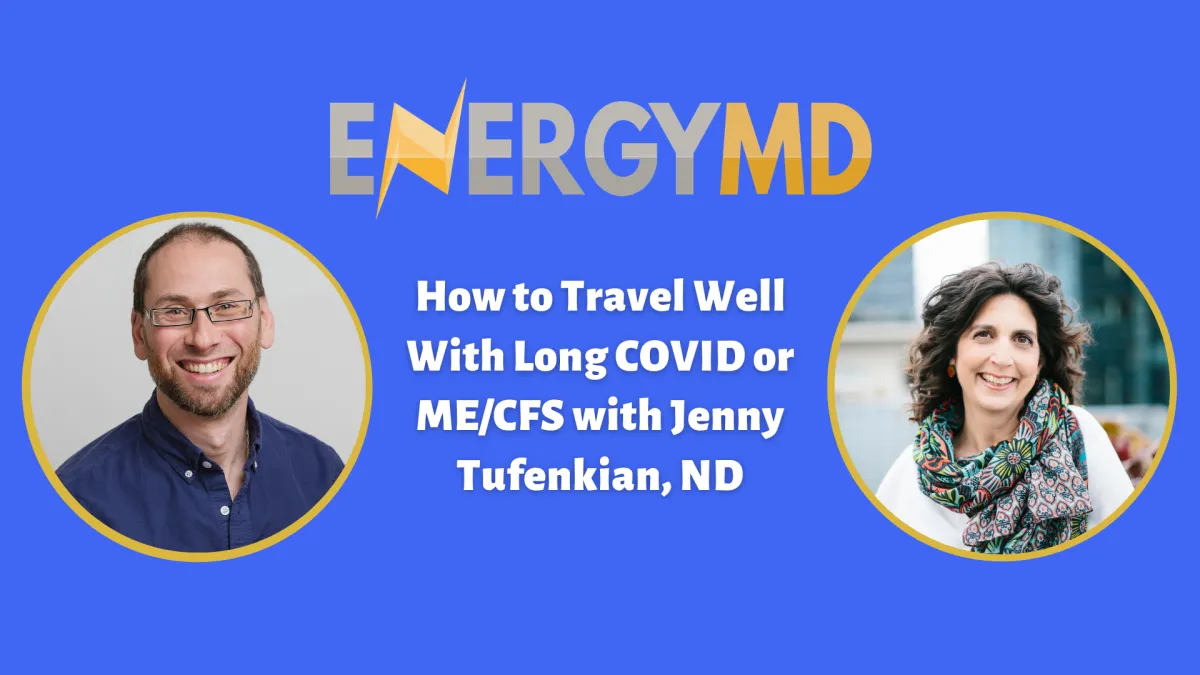
How to Travel Well With Long COVID or ME/CFS with Jenny Tufenkian, ND

How to Travel Well With Long COVID or ME/CFS with Jenny Tufenkian, ND
00:00
So if you're going to be traveling this summer and you might be concerned about how you're going to do if you've got long COVID or chronic fatigue syndrome, you want to stay healthy, you want to stay safe. And so I'm really excited because today I'm going to be talking with my good friend, Dr. Jenny Tufenkian, who is also an ME/CFS and long COVID expert. And we're going to be talking about how to travel safely for our population. So let's learn a little bit about her. So Dr. Jenny Tufenkian is a licensed naturopathic physician with 20 years of experience
00:37
specializing in long COVID and chronic fatigue syndrome or ME-CFS fatigue. After overcoming chronic fatigue herself, she developed a transformative system targeting the five core root causes of chronic fatigue ME. Her integrative approach combines functional medicine with deep subconscious work to help exhausted professionals reclaim their energy and vitality. Dr. Tufenkian earned her medical degree and completed her residency at the National University of Natural Medicine.
01:07
She is also a mom of two, happily married and loves her time outdoors and in the kitchen. Jenny, thanks so much for joining me today. Thank you so much for having me, Evan. It's always a pleasure to see you. Indeed, always a pleasure. I mean, there's obviously people in our community who aren't going to be able to travel or who are concerned about traveling. I feel like we probably should acknowledge that first before we kind of dive in. Is there anything you'd like to say to those people? Yeah, I do want to say some things to you. So a lot of the concepts that we're talking about today can pertain
01:41
to you because for you travel may be going to the doctor's office. or travel for you maybe going just an hour away to your sister-in-law's to go for you know a holiday for a holiday weekend and that is still travel to you and because your nervous system is so sensitive right now and your body is in this place where it's healing but it doesn't have the vitality that you want it to have these a lot of these concepts still apply to you so you may be surprised
02:11
and the other thing I'd say to you is that where you're at now is not forever. That's my view. And I know it's Evan's as well. There's always a potential for you to heal. so, and using the power of your mind, your subconscious and conscious mind is a huge part of healing from these chronic conditions. And so part of your daydreaming and mind mapping and changing the algorithm of your future is literally feeling yourself in places. Part of my healing journey was imagining myself when I was in bed. being able to hike in Europe and feeling it.
02:49
And that really helped reprogram my brain. So here's some tools and tips that you can do for that fun little future fantasy that really helps your physiology. Fun little future fantasy. that even had alliteration. That was unconscious. That was really impressive. Yeah. And I hope, yeah. And I hope everybody listening to this really, really caught all of that because that was, that was, that was so much value right there, Jenny. Thank you. Um, and where you are right now is exactly where you need to be. Right. And this is a spiritual journey. And
03:21
even though it totally sucks right now, you know, doing these tools, like we just had somebody in our program who's graduated like six months ago, she reached back out and she said, I feel better now than I did in 30 years. The majority was because of the nervous system retraining, because of the mindset work, because of the work and all those sorts of things. So don't underestimate those things for people who are listening today. So. So let's dive in. where do we start? Yeah. So let's first of all talk about travel. So this has been something that has been a passion sub project in mind for decades where I had people coming
03:56
in when I had the brick and mortar clinic and I'd have people come in and talk to me about, know, I'm taking this trip. What do I need to take? And it got me thinking about travel and I myself traveled a lot. My husband is from Britain and I traveled to the UK many times with small children. And part of this time is actually when I had ME-CFS and I was very, very sick during some of those trips. And I began to realize what it was that I could do to support my body so that I didn't get worse when I traveled for vacations or to just be
04:30
with my family. And so there's a lot of places to begin to think about. So first of all, like you said, where you are is where you're meant to be. So I think that, you know, there are people on different places in their journey with ME-CFS and long COVID. Some of you are super high functioning and you do well as long as you stay within your energy container. But when you kind of over exert and overdo it, that's when you're really vulnerable to either, either get that post exertional malaise and, or to just be vulnerable to get sick. Right. And
05:05
so for you, This is really important to listen to because it's so easy when you're functioning at that level and you look so good. You go to that conference for work and you stay up too late and you, you know, go to the bar to network and do all those things. And then you pay for it. The other thing is it's really easy. If you're just out for vacation for you to, you know, you're feeling so good. And then you, you know, you do the bike ride and then again, you go out for dinner and you eat that. dessert because it looks so good and you sort of start pushing your limits. So for you, it's really great. It's also great for the people,
05:40
for those of you who are more on the struggle bus right now, where you know, you're going on vacation and I get it. If you're feeling that fear, you know, you're supposed to be excited about that holiday that's coming up with your family, but you're secretly worrying if you can make it. And I've been there, you know, where the family's packing up to go to the beach for the weekend. And I was in my head going, I don't know. I don't know what this is going to do for me. I don't know if I'm going to be okay going here. And I personally kept it a secret. And so I want you to know that um there's, you know, this is a place
06:15
where we're going to talk about those things that maybe you are afraid to share or talk about with other people when you're traveling. So I'll talk about those sort of different pieces. So there's a concept I call 'bubble up,' and bubbling up is where you really are protecting yourself. And you and I I both are in agreement that we're more than just this physical body. We're this physical, mental, emotional energy body as well. And many of us who have these conditions, many,
06:48
not all, but many are empathic and pick up energy from environments, from other people around us, from family members, from people in the grocery store. And that can impact our energy levels and it impacts that nervous system. Just like you mentioned at the beginning, that person who did so well in your program with the nervous system retraining. You know, we're finding out more and more that those of us that are empathic, the more tools we have to work with our nervous system, the more we can help ourselves. So that's one of the things that we're talking about is bubbling up. So bubble up is having that toolkit so that
07:21
you can protect yourself when you're in transition. So whether that's going to the doctor's office, going out to a beach for the weekend, or traveling to Europe like I'm doing on Sunday. Did I say I was excited? And yes, sometimes a bit nervous. I will be honest, you know, about it. That's partly why I can talk about this right now, because I'm living it at this time. So I'm going out on the plane and here are the things that I do when I'm doing plane travel. I make sure that I have things to protect my senses because an airplane
07:57
or a car, or you know, even a grocery store can be a lot for a nervous system. So I take my noise canceling headphones, which have been life-changing for me in terms of travel. And I also have programmed on my phone music or sounds that soothe me. And so for you, that's punk rock or Chopin. It's like doing what it is that serves you. I have... I have a certain piece of music that I listen to every time I take off and land. And that has programmed
08:31
my nervous system over time to know that, okay, now I'm on the plane. Now I'm in a place where I'm going to be, you know, settling in and I'm making this transition to this journey. The other sensations that I will work on is a sense of smell. A lot of us have very acute senses of smell. And so using essential oils that work for me that help my body ground, I try to be respectful of those around me as well and not overwhelm them, but there are some times when having a little bit of an oil that grounds me or feels like it clears my energy
09:06
field can be very helpful for me. um The sight is very important. So I usually travel with a scarf around my neck for a couple of reasons. One, There's this energy system on the back of your neck in Chinese medicine. There's these gates back here. Getting cold wind on them can actually open up your risk for getting infections. And just being in an airplane and having that air filter coming down on your neck can actually cause you to get this kind of coldness in your
09:37
body that can lead it to be more susceptible to getting an infection. Same thing with getting air conditioning. The other reason I carry a scarf is so that I can um cover my eyes and I can control when the flight cabin is dark or light for me. And that's a way of controlling my things. I'm smiling because somebody took a picture of me and my family. I was traveling to Armenia, which was a 33 hour trip with my young child and my dad and mom. My dad had
10:07
already, he already had a... a brain disease at that time, so he was using walking sticks, his brain wasn't totally there. It's a miracle we did this trip with him. And there was a point where I was bubbled up and I just looked like I was in a cocoon because I wrapped, I had a blanket over me and I had my head shawl on and I had my headphones on and I was in this deep state of relaxation in the plane. One of the things that I have said for years, is that part of the healing journey is being willing to be weird and to just not care that
10:45
you're doing something different from everybody else around you, whether that's ordering different food, interrogating the wait staff about what's in the meal, whether it's, you know, doing yoga in the airport or bubbling up and looking strange on the plane. Like I could care less what people think of me because I'm taking care of my body. And so that's one of the concepts, you know, what is it that would serve you to bubble up? You know, what is it that annoys you when you're on an airplane or in car travel? What is it that you could bring in to soothe yourself asking yourself those things and then putting that kit together
11:20
and that program together? Another piece of bubble up for me is making sure that my physical body is being supported through hydration and nutrition. And so I'm really, I'm really, I drink a lot of water, but I really make sure that I stay hydrated when I'm flying. And actually beginning three days before you leave is even better to just up that fluid level a little bit more. And I carry my own water bottle and I stay hydrated. And I also travel
11:51
with electrolytes. I also carry my own food. And I know now a lot more people do that, but I've been doing it for a long time. And I find that making sure that I'm getting the vegetables and the protein I need when I'm flying makes my body really happy. And some people easily get constipated when they're traveling or they get diarrhea because they're stressed out. So for me, staying on my consistent diet really has helped my body stay strong when I'm traveling. And again, whether it's car travel or airplane travel, these things pertain. Wonderful. Yeah,
12:28
I got a couple questions about those before we move on. Yeah, and one of the things that I found also in terms of the food is that you can go on and oftentimes you can order a meal ahead of time. And I do do that. I order a meal ahead of time. You can order a gluten free or vegan or whatever you are. Sometimes one of the hacks is some of the some of the some of the other meals can actually be quite good on an airplane and taste better.
12:58
But and I still carry my own food. And the reason why is that sometimes that food just doesn't look good to me. And it doesn't feel like it has the mana or life force that my body needs. Whereas when I bring my own, I have travel vegetables that I know travel well, and I'll bring those with me. And I have kind of my own travel snacks that I bring with me. And I just know I have those no matter what. Yeah. Yeah. And I find that, you know, fresh fruit and veg oftentimes is really nice on those flights too. um had this really, I was
13:35
traveling with my grandma. had the blessed experience of traveling with my grandma. This was decades ago and she needed to move from a retirement home here in Portland to Pennsylvania where her, where my aunt had moved and we were moving my grandma to be next to her. And I was her guide during that journey. And she had dementia. And it was lovely because I was able, she could remember her past. So I actually got to interrogate her about her childhood in a way that I never had before. And I learned so much about her that was really amazing.
14:07
It was quite funny. She always had sort of this, uh she could have a very sarcastic kind of thing about her. And. It was very sweet. I got to buy my grandma an ice cream cone at the airport when we were waiting for our next flight. It was very sweet to buy your grandma a treat. You know, and it was like being a child, you know, for years she was always giving us treats and for me to able to get a treat for my grandma. So she's sitting there with her chocolate ice cream cone and I pull out my snack, which is, which are steamed beets.
14:40
And so I have my steamed beets and she looks at me and she goes, so what? you're going to live to a hundred and I'm going to die at 96. So now whenever I pull open my vegetables, I laugh and I think of my grandma. Well, and I think that there's, you know, a lot of it, you know, in terms of the mindset around it, when you're asking for what you need, when you're preparing for it, like do not be embarrassed. Yeah, you know be proud of what
15:17
you're doing. You're choosing yourself. You're making good decisions when you ask for what you need assume that the other person wants what you Your best the best thing for you, you know what I mean? And so if you have a need you ask for it, you know. Yeah, I think that's an important part of this too. I was going to comment I love the bubble up idea and one of the things that I tell empaths also is to Literally create a bubble around you. This is one of the things that I think Judith Orloff talks about, you know, this
15:50
idea and I coach people on this also when you're going out into the world To think about like, okay, I'm now putting this bubble around me, and only positive energies are allowed to come in exactly. Yeah I go ahead I totally agree. do the same thing and I and I talk and that's also part of the bubble up and we can talk about the physical, the mental, emotional and the energetic levels of bubbling up and that energy level is that level that you can't see. And So, you know, we have this egg-shaped kind of energy field around us. And sometimes
16:24
when you're meditating, you want to let that be quite big because that's your expansive state. But when you are out in public or traveling or doing things, you want to bring that energy in and it's literally bringing it in like under just really appreciating that it is real and bringing that in and bringing it closer to you when you're traveling through. And I love what you said about that filter, about setting that filter so that only the good comes in. And then when you start, if
16:55
you start feeling your nervous system beginning to dysregulate, so knowing what that feels like for you. So I know for me, it's that kind of tightening pit in my stomach where my upper solar plexus starts to feel tight. Maybe in the past, I would um get really nauseated before I understood what that was decades ago. And it made it hard to eat or drink. And it could kind of become that vicious cycle of nervous system dysregulation that we see so much in our clients. When I now that I understand what that is. I can
17:28
go, oh, okay, I'm feeling that tightness right now. I'm feeling some stress in my body. I'm in line to go through security or something like that. And I can be like, oh, okay, what are some choices of things I can do right now? And this is a three-step process that I guide people through in terms of shifting their emotional or energetic body. And the first one is just noticing or acknowledging that there is a shift. And then the second one is deciding if you want to change or not. Sometimes we're in a bad mood and we just want to be there like, no, I just want to be angry. Thank you very much. I'm like, great. Have your anger.
18:01
Enjoy it. Hopefully you don't hurt somebody in the process, but just if you just need to be pissed off, be pissed off. But often we're like, yeah, okay. I don't really want to be a stress bucket right now. And then the third is, is grabbing a tool out of your toolkit. And I know you teach a lot in your programs. you know, some really easy things we can do One is the five-seven-eight breath. So just breathing in for five, holding for seven and expelling for eight. This is one that I found to be great when I'm traveling because literally I can be walking through a city street trying to figure out if I have the right bus route
18:35
or not. And you know, feeling kind of stressed about and I could just do the five seven eight breath and it helps calm my nervous system. Or the second one I really like, you know, again, I'm in TSA, I'm in line, I can orient. And that orienting is a somatic practice where we just look around, you know, look down at the ground, look at the wall, look at the ceiling, look to your sides, you know, where am I in space? And this brings you to the present now to your very first comment about wherever you are now is where you're meant to be. So
19:07
much of our stress is because we're future tripping and past tripping and we're not being present right here in this very moment. And honestly, right now, right. All of us right in this very moment are okay. We're still here. And so bringing ourselves to now can be really beneficial. And just a third tip, you know, again, whether you're up in the plane or you're in a car or you're sitting in the doctor's office, just, there's a really easy thing that you can do of just connecting with your body and just even grabbing these two fingers. uh It's a
19:41
move in some ancient Chinese medicine arts where it can calm the nervous system. or just stroking, touching your body, like rubbing your arms like this or rubbing your legs or your thighs can really help you reorient back to your body. Wonderful. Yeah. A couple that I like to do, I like to do the Jin Shin Jitsu where you're basically, your one hand is grabbing the thumb of the other one and that's worry. In Jin Shin Jitsu, it's worry fast, F-A-S-T. So whichever finger you grab is what you're working on. So there's worry with the thumb. and then fear,
20:16
anger, sadness, and trying too hard. That's so cool. I didn't know all of those. So this is a Jin Shin Jitsu thing. I used that term because I didn't want to throw a big thing out there. I had no idea you knew about Jin Shin Jitsu. So few people know about it. Yeah. Yeah. So that's fear and anger. You're grabbing those too. Yeah. You can kind of do this and you can grab all of them at the same time. Yeah. But oftentimes holding one at a time and having the hand goes over the finger, not under. And you can just, and you hold it basically
20:53
until it pulses. Yeah, right. And then I like to do the other hand. And it's so interesting, because sometimes you'll be in a state where as soon as you grab it, you'll feel the pulsing. And other times you have to wait what feels like hours. So let's just do that against people, basically you have pulses when you're doing Jin Shin Jitsu. So you're waiting until you can feel the pulse. And I was taught to wait until you're feeling it kind of regulate together because you may feel this hand pulse
21:24
and this hand pulse and they're not matched up. But I was taught to wait until I feel that they're in sync. Is that how you do it as well? I guess so, because it is a little bit chaotic until it syncs. Exactly. Right. Right. And so that's really what we're doing. And since we're talking about it now, we might as well complete it. And it's something that you can do. I mean, just standing somewhere, holding your hands at your waist. Yeah, it's really good. Then you can combine that
22:00
with the breath work too. because that's kind of flicking more in your parasympathetic and it really helps to ground you. Yeah, that's really super cool. Yeah, and the finger grabbing, uh when I hosted the summit, talked to a brilliant Chinese uh medicine physician and he taught me this baby hands move, which is sort of an adaptation to what you're showing with the Jin Shin Jitsu. And when you hold like this, they call that baby hands. And what's interesting is that it reflects back. If you just hold it when you're really
22:32
wigged out and stressed out you can just hold this and Just breathe and just feel your hands doing this. It doesn't have to be super tight and it resets the nervous system and Think about the feedback going through the nervous system, going to all these nerves that are part of the parasympathetic chain and It was interesting because I had interviewed him. I'd learned this and then I traveled to New Zealand, and I ended up having a very stressful thing happen to me where I was in a very bad way, and it
23:07
was so great because I just laid there and I just did this and it was so helpful. It was the first time I'd used it and it was so helpful. I was glad that I knew that. It's just about remembering these things, you know? Put it on your phone, put it on a car, put it in your pocket, pull it out when you need it. What I, what I recommend, and this is what I do myself, and this is what I recommend to my clients and patients is to start bringing these tools in now because we all need them. I mean, the world is a really
23:38
stressful time. If you're dealing with ME CFS along COVID, your physiology is already in an, in an aggravated, stressed out state. And so nervous system regulation is just part of the medicine we need every day, just like we need to drink this water and eat good food. It's part of what needs attending. And I really think one of the gifts of these times is us, our nervous system is getting so dysregulated that we are getting smarter about understanding what they're saying to us and how to re-regulate them. And the thing is that if you, whatever
24:12
you find works for you, then that becomes a tool in your toolkit. And if you're practicing it every day just to calm yourself down a little bit, then when you really need it, it's going to be natural and easy for you to grab it. You don't have to go like, what was that? That Jenny said on that podcast with Evan. That's right. Yeah. Practice makes permanent. Yeah. Practice makes permanent. I like that. That's good too. Yeah. Wonderful. A couple of other thoughts I had, we recently, we went to Europe in December and, you know, we spent
24:48
about two days per place and we were taking train trips. And it was quite stressful. I think it was mostly stressful for me because I had arranged the travel and I had the apps on my phone. And when I needed a break, I said, 'Okay, we're going to this place. My daughter, can you just put this on your phone and can you direct us? Because I need a break right now. And so don't hesitate to ask other people for help. Also, space out how much time
25:22
you're spending in each place. Two days is usually not enough. Three days is better. Try to anticipate, I mean, the more work that you can do ahead of time, the easier it is. How are you going to get from the train station to your hotel? Oftentimes these are things that we forget about. Like, can you do it by a taxi? Now we have AI. And so AI can really help if you have a rough idea, say: I want you to give me every single step in this process. I've got two weeks I'm going to go from here to here These are the cities that I want to hit or give me
25:55
ideas on places that I can go. So anything that you can do to decrease your stress in this process whether it is planning whether it's in the actual moment, you know, like um and obviously the more preparation you can do. You know, I remember when I was traveling in my 20s and I didn't care if I missed a train You know, like everything was always working out, right? And I had all this beautiful long curly hair, you know, how could it not? Right. But now, you know, it's like I'm traveling with my wife and my daughter. I want
26:26
to make sure they're taken care of. My nervous system is different than it was back in the day, before I had chronic fatigue. So, you know, it requires, I think, more preparation and more awareness and and and having more of these tools. And when things don't work out, knowing that they're still going to work out. Yeah. Yeah, I totally agree on both counts. And, you know, it's similar experience in my twenties, hitchhiking in Europe and, you know, just sort of whatever
26:59
happens is what's going to happen. You know, I laugh, my husband and I, when we were just dating, flying to Portugal, getting off the plane in the middle of the night, getting, taking a bus, walking into town and following some guy that didn't even speak the language we did to their house is when that's where we spent the night. mean, you know, none of this Airbnb, check out every single room, talk with the person, be sure there's not mold in the place. You know, none of that. But I think you bring up two really
27:30
good points. I think the, the pre-planning is really helpful and it's been helpful for me too, in my nervous system of looking at the trains and all that kind of stuff. And I think that's right. Pre-planning it. And I think the second thing you said is also really important. Also being able to tap into that, you're still okay, even in the midst of chaos. And this is another really important piece of traveling well that I think is important that I talk about frequently, which is that being able to find your calm in the middle of a storm.
28:02
I was traveling for a conference oh about 10, 15 years ago and all of the flights have been canceled in the airport. You know what that begins to feel like babies are screaming. People are stressed out long lines at the restaurants, no place to sit down and everybody's just on edge. I was going in to go to the bathroom and I just felt this calmness and I looked down and between the men's bathroom and the women's bathroom was a man sitting on the floor meditating. He was a monk and he was wearing a monk's and the amount of calm that was in
28:38
his being. at that moment was so beautiful and such a gift. And it was such a training for me to see what it is that you can bring in in any environment. And so that's one of the things that I work on in myself is how can I be in this, the calm in the eye of the storm as I'm moving through, as I'm going through security, as I'm going in the plane, as I'm traveling as the train station isn't where I thought it was as I missed a train or got on
29:12
the train going the wrong direction or whatever you're doing, you know, all the things that can happen to be able to stay in that which is, you know, can be such a powerful thing to do to just be to know that you're okay. And another part of that for me is another level of being willing to be weird is that I know that my body needs to rest more. consistently than it used to. used to be able to stay up for days and days and I still functioned well.
29:42
May have had something to do with why I was more vulnerable to getting ME-CFS later. Who knows? But I used to be able to think I could do that. Now I know I need to rest and I'm a big believer in uh short power rests throughout the day or throughout a journey. And I travel with a blanket even on short trips. I will travel with, I have a fleecy blanket that I wrap up and I put in my backpack because that can be a pillow on a plane. That can be something
30:14
that keeps me warm if the temperature's not right. It can also be a way for me to create a space in an airport if there's a layover. I've been in long layovers. Sometimes I take a yoga mat with me as well. If I know I'm going to have a long layover somewhere so I can do yoga during that three or four hour break and then that kind of has created like a space for my family to hang out. It's where we have the yoga mat. And, you know, it may sound strange, but for us, it created a sense of, of safety and of comfort because I've created my, my
30:48
comfortable zone that we get to be in. Wonderful. So let's talk about products, What are some of your favorites that you like to travel with? Yeah. So there's a lot of things, I mean, the immune system is huge, right? And so there's a couple things. First, I wanna talk about masking because masking is one of those topics that people often are on two sides of a very defined fence. I may come across as being different from others, which again, I'm fine with. And
31:21
I think that, know, personally, I do think that a good high quality mask, N95, KN95 does really protect you from respiratory infections and that can be beneficial. For some of you, you may find it really stressful to have that mask on when you're flying or in a space. so for some of you, you may choose not to mask or you may choose to wear a different kind of mask. And some people, you know, there are people in the long COVID ME
31:52
CFS space who say you should always mask. Everyone should mask. And I understand where you're coming from from that. And then there are other people who say we should never mask. We shouldn't have to mask. It's dangerous to mask. My experience is that I carry masks with me and I frankly use my intuition and also a sense of how am I right now? Because I know that my risk for getting an infection of anything goes
32:23
up if I'm not feeling as strong in myself, both on that physical, mental, emotional and energetic level. If I just don't feel like I've got it, then I may want to mask to protect myself because it is helping me because I'm not able to bring it in a way that I want to. And then the other time, sometimes I walk into a space, I don't know about you, but sometimes I walk into a space and I'm like, there is something going on here that I do not want to interact with. And so I put my mask on. um You know, do I prefer flying without a mask? Yes, of
32:56
course I do. Another thing that I did, I know when the pandemic was deep and rich was I would carry a surgical mask, which I frankly don't think protects us as well, but I was more comfortable wearing that while I was sleeping. than a KN95 because I felt like I could breathe easier through it and I felt like it gave me some protection. So just wanted to talk about the masking thing because it's just one of those places where we get divided and I don't think we need to be. You can decide what you're comfortable with. In terms of supplementation, so I always want to talk about to boost your immune system
33:30
while traveling. It's important to have things in your toolkit in case you feel like you're coming down with something is important. And then if you're flat out sick, it's important to have those. And I travel with all of those things. then I always, um and never underestimate the power of your mind in this situation. I have a thing that I do if I feel like I'm getting sick that I've taught to other people. And if we have time, I'm happy to share it where you're really tapping into the power of your own mind to shift your physiology
34:03
so that you can avoid getting sick. The things that I carry with me when I'm traveling, so um I have a... it's changed over the years, but I take some kind of... um right now what I've been using is I use some kind of an antibacterial, antiviral that I take internally. I've been using an essential oil product that has a number of different essential oils in it. It's On Guard from doTERRA. That's the gel cap that I travel with because I find it works so well. I've used other products like EHB from Integrative Therapeutics, which
34:39
has echinacea, hydrastis, berberine in it. It has vitamin A, zinc. It's a great kind of across-the-board thing. I've used homeopathics. Whatever works for your immune system can be great to take before you leave. Not because you're sick, but just as a preventative without overdosing, but just taking one. I find that has been really helpful and it's something I've done that I recommend for a lot of people if it's a good fit for you. Something that
35:10
I've discovered is there are some essential oils that through inhaling them through your nose can actually reduce the replication of viruses in the back of your sinuses. And so I take eucalyptus oil, which you do not wanna take internally because it's toxic, but a pure eucalyptus oil, put a drop on my wrist and then I plug a nostril and I sniff it up and I do the other side and just getting the room therapy of that can be really beneficial for decreasing population of things going into, know, for replicant sinuses. I'm sorry. The
35:44
virus is replicating in the back of your sinuses. As can doing different kinds of nasal rinse, you know, doing a neti pot while you're traveling. If you're able to get to clean enough water can be really beneficial for decreasing exposure. while you're flying, you know, once you get somewhere doing a NETI pot. One of the things that I do if I'm at a big conference where it's thousands of people and people are coughing and sneezing all around me is that I will do that eucalyptus before I go into the conference room during lunchtime, go back to my hotel
36:18
room, take some immune support of things and then do the eucalyptus again and go back in. Another newer one for me right now is, it's the beta-glucan. I think beta-glucan is great. I've really started using that a lot and I found it to be really helpful for immune support. For those of you who have immune systems that have gone haywire with your long COVID ME-CFS, your immune system is either under-functioning or over-functioning. These beta-glucans seem to be really helpful for balancing things out.
36:52
And I find it really helpful when I'm feeling like I'm coming down with something. It's also great for chronic conditions. And most recently been finding it's really helpful for allergies as well, which means it's also great for that mast cell activation histamine type of thing. So it's kind of one of those that I've been going, wow, this one is really helpful. Of course, our gut is where most of our immune function happens. And so supporting that gut with good healthy diets. I know when you're in the airport
37:25
and on the airplane, it's the time when you want to buy the M&Ms and get the french fries and have the drink. I am not in that camp. I am in the opposite camp. That's the time to drink your water, eat the foods that you know are good for you and say, thank you very much. I'll have a sparkling water with lime and support your body. It's also a great time to take your probiotics and traveling with really good probiotics I think is very important to reduce the risk of gastrointestinal infections,
37:59
to boost your immune system from respiratory infections. And so that's just an absolute 100% something that I take with me. And I take extra in case somebody does get some kind of a GI bug or food poisoning or something like that while we're traveling. Other things that I travel with, magnesium is fantastic. And m I also like using homeopathics to help with jet lag. Wonderful. You like that jet lag product? It's called No Jet Lag. It's
38:31
Miers Labs from New Zealand. Yeah, it's unavailable right now. They think it's going to be back online in a week or two, just FYI. Very cool. And I would imagine that the recommendations would be different if you're going to travel in a developing country. Absolutely. Yeah, the recommendations are different based on where you are. I've done one-on-ones with people. It's been really fun. I've had the I've had the people who I call, I've had trips where my whole suitcase was filled with stuff. I mean, that's when I went to Mexico to a really remote
39:05
beach where the closest medical care was an hour and a half drive. And I'm thinking if I'm the highest trained medical provider in the area, I want to be sure that I have the things I need in case somebody has an anaphylactic reaction to some rare shellfish thing. Like I sort of went totally overboard and packed a whole clinic. And I've advised people who are at that level to the 25 year old who's backpacking and says okay I have you know, I have like two ounces of weight that I can dedicate to my health kit What is that? And
39:40
so, you know, there are some things that you can take with you that can be incredibly supportive like some homeopathic remedies to help with trauma, getting too chilled, and you know, with injuries and a couple of anti-infective things that can really give you a lot of mileage in terms of supporting your body in different environments. Yeah. And don't hesitate to ask for help or to research or to ask AI. I recently went on a trip just to San Diego to visit my cousins and one of my cousins came out of the water and he was bleeding. He had a puncture
40:16
wound and everybody was like, Oh, it was probably just a jellyfish. And I kind of researched, I pulled up AI and I asked like, what could it possibly be? And it said it could possibly be a stingray. Yeah. Which could potentially kill this person. so I followed him up back to the house. We put him in boiling hot water. We followed the protocol. He ended up having some cramping, which is a sign that it's like progressing and it can lead to, you know, disability and all these awful things. At one point I thought I was going to have to go to the ER. It was really good that I had that information at my fingertips, because I didn't
40:50
know, I mean, I'm not a beach person. I didn't know what was going on. And so, you know, doing some research and having an understanding, even if something happens in the moment, like what's the worst thing that this could be and just making sure that you're addressing that as well. That's a bit of a digression, but I think it's important to say. I don't think it's a digression. think it's a really great point. we have so much information available to us at times. And I think it's always important to get the
41:20
professional help that you need when you need it. And it's good to err on the side of caution. And I'm always about having your toolkit to be prepared so that if there is an illness or an injury, you have things that you can do before or on the way to the hospital that are helping, right? Because being empowered, you're going to help the situation, but you're also going to help your nervous system and the other people's nervous system that you're helping because you're doing something. Right. And you're not just feeling powerless, which is another one of the big principles that I really believe that this era and this time
41:55
is about being empowered in your own healthcare. And the more that you understand what your body's saying to you, what are those whispers? What if it's screaming at you now? What is it saying to you? Can you listen to it? And it's just whispering. So it doesn't need to scream. And you know, what is it that you can do to shift your physiology on that physical mental, emotional, or energetic level so that you can experience more vitality. Getting empowered it just feels so good Absolutely. Yeah, yeah, and and I'll just comment a little bit on some of the things that I do. I always carry a mask with me. I actually
42:30
carry one in my back pocket at all times. Yeah, I do that when I'm taking the garbage out I do it when I'm out in public and I smell something when I'm on an airplane. Sometimes it's just because all of a sudden you can smell the gas in the cabin. Or the toilet. Right. Or the toilet. Exactly. Yeah. And it can be very comforting, I know for some people it can be claustrophobic, but I do feel like I have a little bit of a bubble when I put that on. It's almost like I've got my... my blanket, you know, that's
43:08
kind of like pulled up over my nose, you know, so. Yes. And one of the things that can be nice to do, and I did this during the pandemic when I had to go to the grocery store and everybody was so stressed out, is I put essential oils that I found calming on the outside of my mask, like a drop of lavender and a drop of lemon. And so that I was smelling those things and it helped calm my nervous system as I was going through. So that's another thing that you can consider doing if that helps you. Yeah, that's great. And I think, you know, since the pandemic, there's a lot of things that I do proactively, just from
43:42
a prevention standpoint where I'm taking a higher dose of vitamin D and vitamin A and zinc and quercetin and using nasal sprays twice a day, you know, just because you're going to be, there's still the chance, you know, of getting COVID, of having an illness or whatever. So continuing those practices when you're traveling is just going to be really beneficial. Yeah, and I think the other thing is knowing what your vulnerabilities are. So if you know that you're mold sensitive and you're traveling, mold is one of those things that's everywhere. And it's really easy to
44:12
get in contact with it when you're traveling, whether it's in a car or in the place that you're staying at. And so one being proactive and asking before you rent a place about possible water damage and mold is not foolproof, but it does help. And the second thing is having your mold kit in terms of the things that you know help your body be able to reduce the reactivity to that mold and having that. And sometimes that comes in the form of doing things through, you know, different kinds of nasal sprays or lavages, because a lot of that
44:43
contact comes through the nose, go into the sinuses and can impact you. kind of knowing ahead of time what it is and then traveling with those will be really beneficial because, you know, you all know. then a mold thing can, know, until you've got it handled, it can knock you out and kind of be a bummer for that trip if you've got that raging headache or full-on brain fog and can't have fun at the beach. Right. Yeah. I always travel with a binder because you just never know what you come in contact with. you know, and if you
45:13
do go to a place that has mold, you know, you turn around and you walk out and you go someplace else. Yeah, and let's underline that because there's that mold soma piece where mold does not want you to do anything different than what you're doing. Mold wants everything to be static and calm and stay the same, because that's where mold is happy, and it takes over your brain and it's easy to not take action even when you know you should. So yes, so it's getting out of the space. And if you absolutely cannot get out, you have no option but to
45:45
opening the window and being near the air. Absolutely. Yeah. And you know, I mean, yes, it does cost money to get out. And sometimes you have to spend a little bit more. Oftentimes you're not going to miss that money. And it's worth your health. I mean, there was a point where we were traveling and we were supposed to take a night train, which was like a train where you're supposed to sleep on it. I thought it'd be a cool experience. It's late by one hour. Then two hours. All of a sudden it's midnight, it's 1am. It's like, okay, I'll deal with this later. I'm going to lose a lot of money, but let's go find a hotel.
46:19
You know what I mean? like, once again, it's like prioritizing, you know, health and safety, you know, and just, I know it's a luxury to say, you know, like, okay, I'm just going to spend a little bit more. I once heard somebody say, a problem is not a problem if you can throw money at it and it goes away. And obviously it's a luxury to be able to say that. And you can do that in different ways, but the idea is that you're just prioritizing your health. Yeah, and I think that whenever you're at a point where you need to make a decision about that, doing one of the tools where you ground
46:52
yourself first is going to allow you to be more creative with your thinking in terms of what your options are and make it easier to communicate with other people in your group about what decision you want to make. You know, are we going to stay or are we going to go? How do you guys feel about this? This is what I need. What do you need? And it can open that conversation up and it can make you again feel so much more integrated and empowered. So your body will thank you for that as well. Yeah. And a lot of it is
47:23
really getting clear, you know, through this work that we're talking about, the mindset, the nervous system retraining, et cetera, about what your values are, you know, and really making decisions that are aligned with your values, because then, you know, things can definitely become more clear. So I totally agree, you know, having that, you know, getting centered, and being like, okay, what are my values and how are they going to play a role in this particular situation? Yeah, and to that point, you know, I used to always catch the cheapest flight I could because that's just what I did. And then when I realized how hard
47:55
it was on my system to get to my family's house in Britain, taking four flights versus two, and you know, what a difference that made. I was like, well, I'm willing to spend the extra couple hundred dollars to get a flight where I have less. where I have less layovers, because my health is a value to me, and you're right, it's a privilege, I get that, and I appreciate that I have that choice. The other thing that I would say is that there are other times where you may be more vulnerable to traveling and to pay attention
48:25
to that. I had a very powerful experience when I was flying to Britain when I had ME-CFS, and I fell into a severe depression when I arrived. I used to have this geeky habit, of grabbing a magazine before I got on a plane, and it was not Red Book or Vanity Fair. It was always Scientific American. And I would get Scientific American and I would read on the plane back in the 90s. And what was so interesting was that issue that I grabbed that trip when
49:00
I got there in the 90s was this breakthrough article in Discovery of how your hormones impact your mood. and how when you are in your, right before your period, what happens to your estrogen and progesterone greatly impacts your mood. And so what had happened is that I happened to book a flight right before my period and the jet lag, the circadian rhythm disruption and the low progesterone estrogen I had in my body at that moment in time. And
49:34
you know, I had ME-CFS as well. So my system was already in this not super strong place, it threw me into the deepest, darkest depression. And it was so interesting. I remember sitting on the floor being in this black mood and reading this and going, oh, this makes so much sense. And then I ended up doing some work that, you know, I know this was, we can talk about this another time, but I ended up kind of coming into some very deep subconscious patterns that also got triggered from that depression, from me being in that place, and I ended up having an opportunity to heal. It became what I call
50:08
a low tide situation. I was feeling so crappy that all the stuff that was in my unconscious I was able to become conscious of and I was able to heal that. So it ended up being a good story in the end. But to that point, if you have the ability, if you're a cycling woman and you have the ability to choose, maybe doing an overnight flight when you're PMSing is not the right time to do it. Choosing another time. And they have done studies that surgeries, are people have more challenges with their surgeries if they book them during that time as well. So if you have an elective surgery, choosing a time according to your
50:42
menstrual cycle that works best for your health is a good idea. Yeah. Really wise. Yeah. Well, we've got, uh, we're over time, but, before we adjourn, I do want to hear about that. Um, avoid getting sick practice that you mentioned. Yeah, sure. Okay, great. So this is, this is one of those ninja hacks and, um, I. So the story behind this, how I, how I came up creating this, this is, this is my own creation that came out of, had taken a course in, uh well, I'll just say, so I was in clinic one of those days where, know, I was completely
51:17
booked with patients all day long, came in feeling great. was flu season by about four o'clock. I started feeling like something's coming on and you know, the flu comes on really fast. You can feel great in the morning and feel terrible by the end of the day. the time I, my last patient, I was like, uh, oh, took my temperature. 102 and I was clearly had the flu and I was thinking oh no I've got to cancel all my patients for the next week. How the heck am I'm going to get them in? I'm fully booked out for months. No one likes to reschedule a week's worth
51:49
of patients. I drive home. I sit in the driveway and I go well I just took this PSYCH-K class and I learned this. I learned some strategies on how to talk to my subconscious mind. How about if I try some of that right now? So I ended up doing this exercise. And what you do first is I said, do I want to be sick or not? Because sometimes we get sick and there's a secondary gain. We want to break, we want to slow down. We don't want to do something. So I asked, do I really want to get sick or not? The answer was no, I really didn't. It's
52:21
like, okay, great. And then I did the full thing I do, a muscle testing, but there's a way you can do without muscle testing. So I just... set the intention that I am healthy physically, mentally, emotionally, and spiritually. You can use the word energetically, it's the same thing. I'm healthy physically, mentally, emotionally, and energetically. And then I went into a whole brain posture, which is where you cross your knees or your ankles. Right now I have my knees crossed over my lap, and then you can cross your hands. You can put
52:52
your arms like this and go into what they call prayer pose for yoga, or you can just literally cross your hands like this. And this is a whole brain posture. It integrates the left and right side of the brain. And you just stay here and you just repeat the words. I'm healthy physically, mentally, emotionally and spiritually. And you bring in the power. Now the ninjas thing here is you have the power and the ability to heal yourself. You really do. There are study after study. There are placebo studies. There are nocebo studies. You can do this.
53:26
And so this is letting your body know that there's no space for this virus, for this infection in you at this time. You are not open to that. You are radiating health and vitality on the physical, mental, emotional, and energetic level. And you hold that and you hold this space, you hold this posture until you feel a shift. It's usually just a minute or two that you hold it. And then once you hold it, do, there's a mudra that's called, it's a save mudra. and you put your fingertips like this and you just look down for five seconds or 10 seconds with
54:00
your eyes open and then with your eyes closed and that's like a lock and it sets in the subconscious mind the thing that you just did. I did that in the car. I had the fever. I was sick. I came in the house, my husband had cooked dinner, kids were at the table and I decided to not say anything about, I'm sick, I've got the flu. I decided to just not say anything because I just told my brain I was well. After dinner, went upstairs, did the process again, just for extra good measure. Went to bed, woke up, felt great. Nothing. Absolutely nothing. Stayed
54:36
well the whole week, stayed well the whole season. I've since taught that in workshops, lectures. I teach it in my travel well program. And there are a couple of different variations I've used, but that's like the solid gold one that works. And I really encourage you all to try it so that you can really feel the power of your own ability to heal. Amazing. Tell us a little bit more about your travel well program. Oh, my travel well program. this is a, I've had a travel guide that's been out there and it's been helping people for decades, helping them
55:08
travel. But I've decided to do a little program and it's coming up this spring. It's going to be just a couple of weeks, short little program so that you can get the tools in your hands to travel well. If you're at all interested, I'm going to do a beta launch. If you're at all interested, then you should follow me and get on my email list and you'll be first to know. We'll be doing it when I come back from Italy in early June. And if you're listening to this after that, it'll be up and you can go ahead and check it out.
55:40
So yeah, I'm really excited about it because I think everybody needs to travel well, but I think those of us who have ME/CFS or long COVID especially, you're just more vulnerable and there's no reason you can't continue to support your health and to maintain your vitality and to heal. Even when you're out adventuring, whether it's for fun or for work. And I mean, you and I know that people go to conferences and they come back sick. You and I know what to do and others don't. And I think it's a good time to get that news out there
56:10
so that you can all stay well. Amen. This has been a wonderful conversation today, Dr. Jenny. Where's the best place that people can go to get on that email list to learn more about you? Yeah, reach out, go to my website drjennytufenkian.com. That's drjennytufenkian.com and get on our email list and reach out to my team and we'll be sure to notify you. And we'll drop that link around this video and then we'll also drop your quiz down there as well for people who are... Tell us a little bit about the quiz. The quiz is to find out what your energy type
56:44
is, whether, you know, which of the five root causes is the dominant one for you. Wonderful. Dr. Jenny, thanks so much for being with me today. Always a pleasure. And for those of you who are listening, if you want to get more information like this, please like and subscribe and we'll see you next time. Thank you so much. So if you have chronic fatigue, whether it's from long COVID or chronic fatigue syndrome, go ahead and click the link below. to watch my latest masterclass where I go deep into our four-step process that has helped thousands
57:17
of others resolve their symptoms naturally. After you watch that video, if you're interested in seeing if we're a good fit to work together, you can then get on a free call with me. All right, thanks so much. I'll see you over there. I hope you learned something on today's podcast. If you did, please share it with your friends and family and leave us a five-star review on iTunes. It's really helpful for getting this information out to more people who desperately
57:47
need it. Sharing all the experts I know and love and the powerful tips I have is one of my absolute favorite things to do. Thanks for being part of my community. Just a reminder, this podcast is for educational purposes only and is not a substitute for professional care by a doctor or other qualified medical professional. It is provided with the understanding that it does not constitute medical or other professional advice or services. Thanks for listening and have an amazing day.