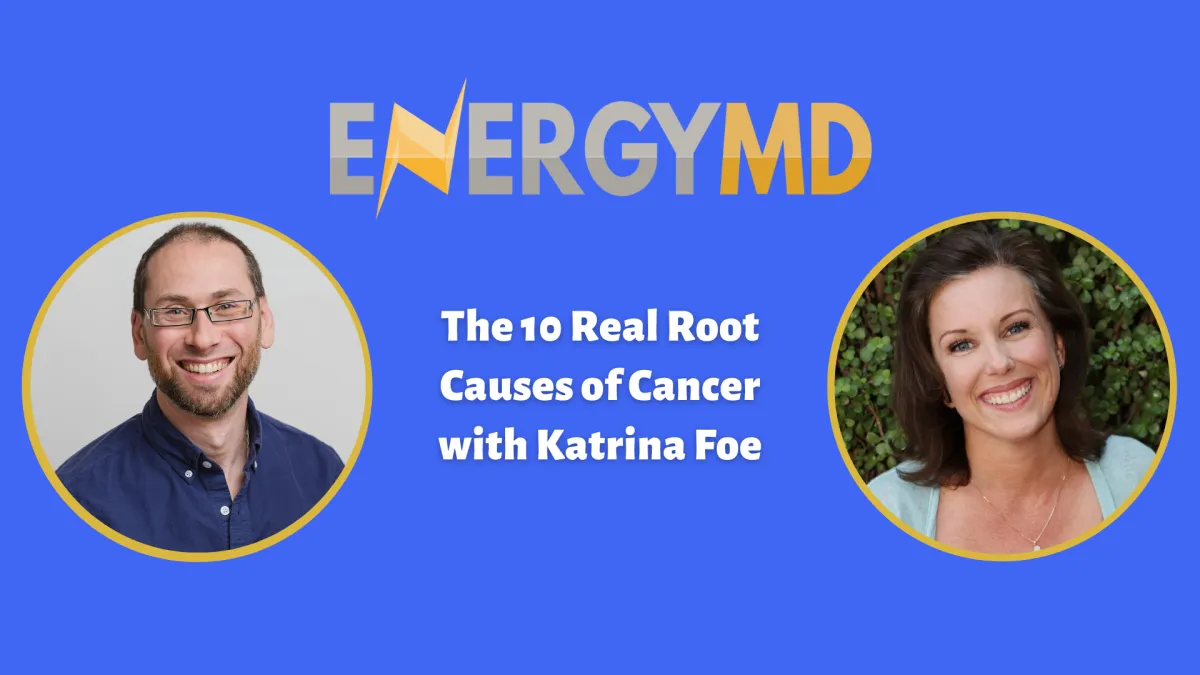
The 10 Real Root Causes of Cancer with Katrina Foe

The 10 Real Root Causes of Cancer with Katrina Foe
00:00
Hey everybody. Welcome back to the EnergyMD Podcast where we help you resolve your long COVID and chronic fatigue syndrome naturally so that you can get back to living your best life. some of you unfortunately have had cancer or know somebody who's had cancer. And so we're going to be talking today with an expert who's going to be sharing all about the root causes of cancer and all the things you need to be looking at.
00:27
to prevent cancer from happening and then also from things you need to look at when you're going through cancer or when you've had post cancer as well. So, let's talk with Katrina Foe today and let's learn a little bit about her. So, she became a functional practitioner after getting her own breast cancer into remission 100 % naturally. She is board certified in holistic nutrition and has been in the health field since she opened her Pilates studio at the age of 24.
00:54
She also homeschooled her seven children while writing her international bestseller, Nutritional Pilates. Katrina currently focuses on helping women with cancer discover why they have cancer so they can learn how to live without fear. Katrina, thanks so much for joining me today. Thank you for having me, Evan. So really excited about this work. I just find it so incredibly important. And you know, a lot of people, you were talking about the why in your bio.
01:22
So let's talk about these root causes. You know, a lot of people think that cancer is caused by a number of different things. Can you dispel some of these myths and kind of tell us what the real root causes are? Absolutely. I was actually doing a webinar last night and I asked the audience, you know, how many things do you think does it take for somebody, you know, to get cancer? Like how many root cause drivers? And I was kind of shocked because almost all of them, had a ton of responses and they're like one and
01:51
That's the biggest thing that people I think miss because when we're looking at root cause drivers, there's usually seven or eight and this is where it gets kind of sticky and they overlap and intertwine. ah But they're all things that I'm sure your audience has heard about and we want to try to tease them out and individually and really get the body supported so it can fight for itself. Brilliant. So where do we start?
02:18
Yeah, so for me with my clients, as well as on my own personal journey, I like to start with testing. I want to know what all the smoking guns on the table, so to speak, what am I dealing with? And then you can kind of have a better chance of prioritizing and figuring out what do you need to start with? How can we multitask? All that kind of stuff. So a wide expanse of testing.
02:48
testing, not just random things, but these are the things that in the research are shown to cause, drive, contribute to cancer. So looking at those and digging in, like which of those are issues for you is probably the best place to start. Excellent. And so what are some of these root causes? You want to go through one at a time or where should we start with those root causes? Yeah, this is the question everyone wants to know. What are they?
03:17
And I can totally go through all of them. They're things you've heard about. These are not rocket science, crazy, new-fangled terms that you've never heard. A lot of times it's just a matter of, like I said, there's so many of them going wrong that then it overwhelms the body's immune system, which was designed to actually seek out and kill rogue cancer cells before they become a tumor. So the first one, metabolic balance at its root, know, Otto Warburg defined
03:46
you cancer as a metabolic disease. So this is a really big deal. And I just can't say enough about the fact that most people have no symptoms. You know, this is not hypoglycemia we're talking about. We're talking about hyper where, you know, you have high blood sugar. It doesn't feel bad. uh I know I was super defensive about this one. I'm like, I don't have blood sugar problems. I eat super healthy. I only eat healthy carbs. I don't eat sugar.
04:12
And that's not what we're talking about. You've got to look at the markers and see what's going on there. uh Trauma. So a lot of us can be familiar, and I'm guessing your audience definitely would be familiar with like trauma manifesting itself in your tissues and causing disruption and disease. uh And what we see is that with cancer, usually the year prior to a diagnosis, there's something that's really hurt that person.
04:41
deeply and they haven't dealt with it. And this could be just a loss of a loved one, not to make light of it, but it could be something kind of every day and they just didn't handle it maybe well, but it's big. And this is the one area that doesn't have objective lab testing to it. So this is where we need to dive in and be mindful. Number three, the microbiome. We all know this is where everything starts. So this means like the parasites, the...
05:10
single-celled organisms, the age pylori, the yeast overgrowth, as well as things like your good microbiome. How is it doing? Is it producing what you need? um And then the digestion, because I find it super offensive if I'm paying a lot of money for expensive organic food and supplements, and then I don't actually get what I think, you know, what's on the label because I don't digest it. So all of that would be in there.
05:38
Um, inflammation, oxidative stress, you know, cancer is a game of inflammation and, um, we want to calm that down as well as say, you know, where, where's the inflammation coming from? So it's kind of a two-pronged in this one hormone balance. So a lot of people, especially when you're talking about breast cancer, think that hormones cause cancer and there's certain, um, ways that you can look at the sex hormones that, know, estrogen dominance and stuff can definitely be a driver.
06:08
But we also want to look at the metabolites on how the body is breaking these hormones down. And that can actually give us really great insight as to whether this is driving the cancer. And then don't forget the thyroid hormones. The thyroid is a really big thing and they kind of get swept under the carpet a lot of times with cancer. And then of course the adrenal hormones, that stress and circadian rhythm. So this is just like normal, how is your body doing in response to stress on an everyday level?
06:36
with the cortisol release and everything, very, very critical. And this is so tied in like, you know, to blood sugar and the inflammation and all these things. you can start to see how these are really tied in. The toxin load, this is probably the one of the biggest. I don't think I've ever seen a client that didn't have something in this category, but we're talking about heavy metals, all these crazy chemicals, and then mold. Mold is a huge driver of cancer that people are not talking about.
07:06
And it was for me with my cancer too. Immune modulation. So this bucket contains things like autoimmune conditions, uh low vitamin D, uh viral infections, Epstein-Barr, things like that. Angiogenesis and metastasis. Most people know what metastasis is. Metastasis is when the tumors left the building and create a new one. And we want to watch that.
07:34
Even more than that, the angiogenesis is where the tumor is signaling and telling your body to make it more blood vessels so that it can get more blood sugar, which is its primary fuel source. So we wanna look for those markers and then address that naturally as well. And then last but not least, this is what everyone thinks causes cancer is the genetics. Now people are thinking about BRCA and that's not very actionable. There's not much you can do with that.
08:04
But um those are the oncological genetics. There's less than five to 10 % of cancers are actually caused by those. What I'm talking about, they're low penetrance ones, are things you can actually do something epigenetically. So diet and lifestyle-wise to turn on and off things like how you emethylate, how you detox, how you make fat-soluble vitamins and things. And we can support these when we know what's going on.
08:33
That's kind of the 10 of them in a quick nutshell. That's awesome. Yeah. So I'm going to dive into some of the questions I have about those. So then in terms of, you know, something actionable that like people can do today, like how much of a difference does diet lifestyle, like how much of a difference does changing those things make in terms of your chance of getting cancer or decreasing your chance of it recurring? It makes a huge difference. A lot.
09:02
bigger difference than most people think. However, when you do the testing, I mean, let me back up. There's a lot in what you just said in terms of things you could do. Literally, it becomes like a full-time job. I gotta do this and I gotta be not stressed and I gotta go to bed on time. Like can make sure this and that is just right. And it can drive people a little crazy. So when you know which of these areas are really the biggest problems for you, you can, like I said, prioritize and pick.
09:31
You know, I can't do it all. I mean, I'll just talk about the toxins for a second. I mean, my clients don't come to me eating, you know, using Colgate and Maybelline and things like that. They've already swapped a lot of this out, but there's there's usually still some chemicals that they maybe don't even know about they're being exposed to. And this is where we can then start the detective work of, OK, now let's where is that coming in so that we don't have to make everything perfect?
10:00
Yeah, that's really smart. I mean, you can't ask people to decrease their stress if you're going to give them stressful protocols, right? Exactly. Yeah. And you can only, I mean, the stuff I'm talking about, these tenure-cause drivers, they're huge. They cover every nook and corner of your life. And so to like change all of it right now and the trauma of just getting a cancer diagnosis or something or dealing with any symptoms you have.
10:27
It's too much, so we have to be strategic and intentional with it. So if sugar feeds cancer, then why in all those chemo rooms do they have like, are they applying people with lots of sugar? I have no idea. This is one of the questions that I send out all the time and no one has an answer and it's horrible because the research is showing that
10:55
If someone's in a ketogenic or fasted state where they're making ketones, when they go into chemo, their blood sugar is in a regulated place. They're not at the high spot. And the tumor is gonna gobble up the chemo way more effectively. It's also good if you're doing radiation and such for similar reasons. And this is just not implemented. I think a lot of it,
11:24
is lack of education. Our doctors are not trained in nutrition. um But some of it's also just they're afraid of cachexia. And if your listeners aren't familiar, this is uh what most cancer clients actually pass away from. It's a wasting away where they get emaciated um until they pass. And so their thing is just eat more.
11:50
eat as much as you can eat whatever you can because anything you eat is the same and this is reflecting their lack of understanding of how the body works and what nutrition is because you know a donut is not the same as you know an avocado it's just not so when we want to stave off cocaxia what's been shown in research as well as clinically is if you're in a ketogenic state that is the most effective way so it does matter what you eat
12:20
Yeah. And what I've seen is that, you know, nurses are very caring individuals and they just want to help people feel better. And the fastest way to do that is, you know, through the sugar taste buds on the tongue, you know, and so they, they're giving them this stuff because they get a, they get a smile for somebody who's not feeling good or whatever. And it's like, yeah, you know, it, um, it tastes good. It makes you happy for the moment, but it, unfortunately it's feeding the cancer. And is that accurate to say it?
12:49
that it's eating the cancer or is it just creating an environment where the cancer can grow? um I would say it is actually feeding the cancer because their blood sugar is going to go up and usually they're fairly metabolically broken so it can go all over the place and then it's giving extra fuel supply to the actual tumor. So I mean it's just giving it to it and when you're actually in the chemotherapy lab that's going to kind of block and mitigate the chemo getting in there.
13:19
So they're actually making the treatment they're doing less effective. uh And I would agree with you 100%, Evan. think the nurses are very well-meaning. uh There's something very stressful about being in there and knowing that you're damaging your body and knowing, I mean, people know what's gonna happen. They're gonna be throwing up and have their hair lost and all this stuff. And it's not fun, it's very scary. But with that,
13:46
you know, here, let's give you a little dopamine hit. It's like the comfort food, whether it's wine or a donut, it doesn't really matter. Like, yes, that feels good right now. But is that going to help later? I'd rather go for like, let's go for the later and maybe get the dopamine hit a different way. Give him a hug or something instead. Yeah. And it seems like there needs to be a little bit of a mindshits mindset shift. And it sounds like maybe
14:16
what they're looking for is, you know, like they're kind of beaten down by the disease. And this is a little reprieve, you know, eating that sugar or like doctor says, I can kind of eat whatever I want because this really sucks as opposed to, is there a particular mindset that people who are successful at beating cancer have? Oh yeah. So the mindset in all the ways is really important. uh I think the
14:44
the passive, I am, you're doing this to me, I'm a victim that most people take on is probably the worst thing you could do. um Engaging, taking ownership. Like I prefer, I would say, you know, if not require my clients to be doing their own, at least meal planning, if they can't actually do the cooking, but they need to own and understand the material of what they're doing and why they're doing it.
15:12
so they can really have that faith and understanding. And I'll tell you, I want them to ask questions. I mean, this is not the popular thing, but what I find is that when people ask questions, they're doing the digging in. They're trying to implement. And when they start to do, when I put this here and did that, it did a weird thing. It's because they tried to do it. That's what I want. And so when they're asking questions to me, that is a really good sign.
15:40
when they just kind of sit back and like let it happen to them, it's not, not usually good. Yeah. So that engagement. Yeah. It's essential no matter whatever you're doing in life, right? If you're more engaged, you're going to be more successful. Yeah. And that's self responsibility. So I just want to rephrase that or kind of dive into that a little more, because it's not that I think or need clients to take ownership of themselves of like,
16:08
I screwed up, I did bad things, I caused it. Nothing like that ever comes out of my mouth except as this kind of a situation. It's more about like, wanna know what caused this so I can go forward and make different choices. There's no shame or blame, but I have ownership of being able to do something different. I'm empowered to make different choices. And that gives, like I said, power. It's very important that people feel that.
16:38
they have some sense of control over what they can do. Yeah, I know that uh my wife, who's a trauma informed mindfulness coach, and she went through chronic fatigue syndrome before I did, one of the ways that she came out of it was with um radical acceptance and complete responsibility. You know, for this, you know, like I accept what's happening to me and what can I do?
17:06
in order to be able to get over this. Exactly. Yes. Yeah, that's it's critical. It's so critical because if you go to the victim place, um usually they just kind of are trying to numb out and there's where the donuts and stuff come in. But also the things that cause it are still sitting there and they're still dealing with it. So at the end of the day, I'm like, why wouldn't it come back? Yeah. And
17:34
And when you talk about like numbing things out, think that, you know, one of the things that I learned as I'm getting older and I continue to do a lot of personal development work is that so much of growth comes from sitting with discomfort. Like when you have discomfort in your body because of things you're thinking about or situations or whatever it is, sitting with it instead of trying to numb it oftentimes can be transformative or trying to, you know,
18:01
just having that mindfulness of noticing, gosh, this is really effing uncomfortable. You just get this cancer diagnosis or whatever it is. We're not really taught how to navigate that. So it sounds like part of the work that you do with people is getting their head on right, is doing this mindset work. Is that correct? Yeah, yeah. My big thing, I mean, I'm not a mindset coach or a counselor or any of these things, but I want them
18:30
biggest thing is to first understand if they have trauma as one of their issues. like, this is the elephant in the room, we need to talk about this and then get some really good tools to do it. And there's a lot of amazing tools out there nowadays. But the big thing is to not ignore it because then it's, you know, it's like ignoring a blood sugar issue and continually eating higher carb meals all the time that are spiking your blood sugar. Then nothing's changing.
19:00
Is something going to change when you're not changing anything? No. So we want to all of that. And people who say, you know, cancer saved my life. I know I've heard that one before several times. They're usually talking about the changes that they've had to make in their lives in order to be able to get over cancer or the fact that the fact that they had cancer that ended up causing them to take a hard look at themselves and go through a some sort of personal development of some sort. Is that accurate?
19:28
Oh yeah, that's me. Yeah, cancer was the biggest gift I ever got and it was a complete answer to prayers, but not in any way that I would have ever like had that play out. But on so many levels, it helped me. So I have bipolar ah and I have not been on meds for decades, but I've kind of white knuckled it. And the whole cancer thing led me to the keto, which I would not have tried otherwise.
19:58
And that also can do a lot in terms of mental illness and putting things in remission. So at this point, like I've got multiple valves to play with, but 100 % remission for like, I don't know, seven, probably eight years now because of the cancer diagnosis. Yeah.
20:22
Yeah, if you look at it as a spiritual path and an opportunity, mean, nobody wants to have bad news like this, but it's the same thing with chronic fatigue and long coded. It's like if you if you and anything in life that's, you you fire from a job, whatever it is, if you look at it as an opportunity for growth as a spiritual path, you can uh you can transform it. I mean, you can look at it in that way and that can be very supportive. Yeah, absolutely. 100 percent. And dealing with that trauma, I mean,
20:51
going through it, it's not fun like you said, but at the other side, you have a whole different capacity for living. Yeah. And you don't want to just survive these illnesses. You want to be at the end, you want to be better than you are before you got it. 100%. Yeah. I think it's really interesting as I get older, I'm kind of like, I want to be better now than I was when I was younger. And there are some things like I can't go on.
21:21
on roller coaster rides anymore, or go through the teacups because I feel like I'm going to vomit while it was better when I was younger. there's a, and my nervous system is like more jacked up. Like I cared a lot less when I got on stage when I was younger. So there's some of those things, but I feel like we do have control and we have more maturity and we have better tools if we want them and we can really be better off. We can just keep getting better as we get older instead of just like surviving. Would you agree?
21:50
Oh my gosh, yes, yes, I'm cheering for that. I'm turning 50 this year and that is very much a part of the thoughts that are going swirling around in my brain recently of like, where do I need to improve and dive into and where do I wanna be? Because when I was younger, it was more about what can I do versus who can I be? And so that shift is really huge and I think that it does come with age.
22:20
Yeah, awesome. So you've mentioned a couple times around the ketogenic diet. um Can you tell us a little bit about like what that is, how that can be? You mentioned it a little bit, but just touch on again how that can be supportive for cancer and then how sustainable it is. Because I know it can be hard for people to continue to do a ketogenic diet. So I guess tell us about what it is, how it helps with cancer and then how sustainable it is. Yeah, all the stuff. So
22:48
A ketogenic diet, I want to separate it out from what's out there in the realm. This is for cancer. It's a very clean diet. This is not, you know, Velveeta and bacon and such. um And we really want to focus on it being nutrient dense. So very high fat, like 80 % of the diet, moderate protein. It's not, again, what's out there of like hamburgers with bacon and stuff on it. It's not high protein.
23:18
This is not Atkins. then, cause too much can actually stimulate the mTOR pathways and be bad for cancer. And then very low carbohydrate. And the carbohydrates you do eat, we want those to be from really nutrient dense vegetables like, you know, broccoli and cauliflower and things like that, that have a lot of sulforaphane and other things that your body will need for healing. So, I mean, this can look so varied. uh
23:47
You do need to have some animal products in your diet. So like I don't work with vegans just because, you know, in order to get enough protein that's of high quality, you'll need some kind of animal product. But that can look different for everybody. So what we do is we, know, okay, here's where we're starting from. I have my clients enter things in ahead of time, not in hindsight. And then when they eat them, they're testing themselves to see, okay, how did I do with that?
24:15
How did that meal affect me? Did it raise my blood sugar? Did my ketones go up? Where am I at? And so we can really do the detective work of figuring out not just am I in ketosis? Because that's important, but we want to get therapeutic levels of ketones because the ketones will actually, they've shown in the research, to slow and stop growth of tumors as well as deal with some different cancer pathways. But doing this, like you said, we want it to be sustainable.
24:45
So now there's some people that are talking about like you shouldn't do it long-term. I just put out there like the ketogenic diet started uh as a relief from epilepsy. So this is a medical therapeutic diet that people would just stay on their entire life. And I know, including myself as well as many other practitioners and clients that have been on it for decades. So the thing then really comes in is, okay,
25:14
you got to personalize it. You know, if you're a cycling woman, that'll look a little different during your cycle, but it's not like you just start eating, you know, pancakes one day. And you have to make it taste good. I'm a super picky eater myself. So to me, if it doesn't taste good, I'm not going to eat it. I'll just skip a meal. And that obviously cannot be sustained all the time. you know, figuring out what tastes good, what doesn't, how can I change it up and watching clients and
25:44
and stuff like they have so many different tastes they like and the ways they do it differently. It's very fun. I really enjoy it. Nice. Yeah. And it's, sounds like it's a, it's pretty balanced. You know, you've got some veggies in there. You've, know, you've got the, protein. And so when you say 80 % fat, can you tell me a little bit about what that looks like? What kind of foods are people using?
26:10
Yeah, I think people usually think that they have like a cup of oil and they're drinking it and like, no, that's disgusting. So it actually looks very similar to foods that you would normally eat. They're just choosing the high fat content. um So for example, if I want say, you know, yogurt and granola for breakfast or something instead of yogurt, I'm going to have sour cream.
26:37
like just straight up sour cream. And I might put a little Stevia in there or something and they'll put instead of granola, I'll do like a keto granola, which is, you know, nut based. And then I can put a few berries on top. I mean, so it kind of looks the same a lot of times. It's just how you choose to do it. You know, for, for salads, you know, you can have a big green salad, put a little like maybe some cheese on it. I love goat cheese personally.
27:05
maybe some cut up chicken, but not very much. Maybe some seeds, maybe even some like chopped up little pieces of apple or beets or something fun. And then a lot of dressing. Like I grew up where it was like you try to put the least amount of dressing possible or you'd even just do like a squeeze of lemon, you know, because fat was bad. And now it's like the opposite. I'm like, let's do like four or five tablespoons of dressing. Cause that's where the important part is.
27:35
So a lot of it comes down to being intentional because you do not get 80 % of your diet in fat ah by accident. It does not happen. ah Most people are not getting anywhere near enough fat when they come to me if they're doing a keto diet. And then a lot of it's just about making it taste good. So yeah, there's fat bombs you can add in, but usually after a couple of months, people don't rely on those that much. They can find how to do it in their food.
28:01
by dressings and sauces and marinades and things like that to really pack it in. Nice. And so high fat dressings would be olive oil? Could be. Could be olive oil based, avocado oil based. A lot times I like to mix it up. We'll put some MCT oil in it. uh Yeah. mean, even things like Hollandaise sauce where it's like egg yolks and butter and such like that. uh
28:28
Oh, and I forgot my favorite. I love to put fat in my drinks. ah So you can mix up and I've got lots of different therapeutic kind of drinks that have the fat in it where you don't even realize you're eating fat. Wow. That's super cool. Is that powder? Do you have a favorite you can share? Okay. My favorite, and I just want to preface this. I love matcha because genetically for me, it actually helps me keep my hormones regulated. Most cancer clients, that's not the case. So I'm just going to put that out there, but
28:58
I'll put some hot water, some heavy cream, just straight up, sometimes some MCT oil or butter in it, and then the matcha, and then I'll put some stevia. If I feel like getting a little crazy, I might also put some peppermint extract or like some pumpkin pie spices or something fun, but I mean, they're better than the ones at Starbucks. I mean, taste-wise too.
29:23
And stevia not only does it taste good and it doesn't raise your blood sugar, but it's also anti-cancer because it's an anti-microbial tincture, right? Yeah. Yeah. I'm a big stevia fan. That's super cool. So what about people who have a hard time with dairy? Yeah, dairy is not required. So personally for me, dairy is like my power food. And I fully acknowledge that that is not the majority of people.
29:51
So you can do it without dairy. It's not as yummy. I obviously am a little biased, but you know, things like coconut oil, coconut cream, all the many forms of coconut can be a great substitute for a lot of the dairy. Yeah, yeah, I agree. That's great. And then so in terms of, we're talking about how it affects blood sugars. What would you consider elevated blood sugars or like what's ideal for not feeding cancer?
30:20
Is that, are you looking at hemoglobin A1C or just the fasting glucose or what do you like to see? Yeah, we're looking at multiple things because you get different pieces of information so that that fasting glucose or glucose anytime that's not right after a meal, I want it to be between 70 and 90. And that's a lot tighter range than most people are talking. As people get more metabolically flexible, you know, it won't go up as high after, you know, a keto meal.
30:48
where it won't go to like 100 or 110 or something, it'll stay within that 70 and 90. That's a really important marker. The Hemoglobin A1C is probably the best marker though, and that's giving you an average of the last three months, kind of how much blood sugar spiking was going on. And so I like that to be under five so that people can really dial that in and...
31:13
The ranges that the lab references are just terrible. I just, people need to know that these are created by the labs taking the average of who is in their area, who is taking that at their lab. uh It has nothing to do with health. And it's so interesting to me because I work 100 % virtual. So I have clients that are in Florida and they have different lab ranges than the people in California.
31:39
I'm like, I'm sorry, are they not all still human? Like, why would that be different? It doesn't even make sense. So, you know, we're looking at different ranges for that stuff. So less than five on a human globin A1C, that is really good. And so that's with um diet, obviously. And what else are you using to help people metabolically? there certain supplements that you like to use? Yeah, it depends on what shows up on their labs. Diet is always the first foundation.
32:09
um You can't out supplement a bad diet, right? But then um if they're having a hard time with the blood sugar and such, things like berberine can be helpful. You just want to be careful that it's appropriate and they don't overdo it because it can send them too low. And then how much protein do you like people to get? mean, the women that you're
32:34
working with or similar to my population, women, know, menopausal women between the ages of 40 and 70 or so. What is the protein levels that you like to see per day? Yeah, it's usually a lot lower than people think, especially when they start looking for recipes because the recipes out there, if it says keto, that really just means, and this is for products too, it just means that it's low carb. It has nothing, they're not looking at the fat level or the protein level, which just blows my mind because that's part of it.
33:01
So I'm looking for people to get an average of 15 to 20 grams per meal. And we want that kind of spread out. uh If you get too much, the body can actually turn it into uh blood sugar with a process called gluconeogenesis, which we don't want to use. And so this is where it is a little person specific. So I give them generic start here, and then we're gonna tweak it. And some of my clients actually do better with a little bit higher.
33:31
some of them have to be even tighter. Gotcha. So then you're getting like 60 grams per day or so protein. Yeah, which is really different than what a lot of kind of optimal health, longevity, you know, coaches are talking about now. Um, but again, this is cancer. We, it's a, it's not just generic. Right. Yeah. Um,
33:55
And then I think it's really so great that you're talking about the microbiome and these infections. You know, I know I read once upon a time that every cancer was found with an infection inside it. Doesn't necessarily mean that it's causal, but there is some sort of association there. And then the toxin load. So what, what other things, I mean, do you find that when you're removing infections and you're removing toxins out of the body that
34:21
hormones and metabolically, people end up improving just from doing that? Yes, but when I mean when I'm working with cancer clients, you know, we need to move everything as fast as possible. So it's like I the way I work is a little different than maybe a regular practitioner where they'll do one or two things, see how it ends up, you know, oh, that's all better. I'm testing all of it right at the beginning.
34:48
And then we're going to move all of it. So it just depends on what's going on. But as long as it all moves, that's what I am focused on. So I don't see that aspect quite as much just because we're trying to compress time a lot. Yeah. No, I totally get that. But they do, they do affect each other big time. Yeah. And anything that's going to stress out the body, whether it's mental, emotional, or physical, like having all this crap in the body when it's not supposed to, or going to
35:15
negatively affect your adrenals and then your hormones and then your blood sugars and all that sort of stuff. And I appreciate that you talked about that you mentioned thyroid because I know that there's, I remember reading about the Gerson protocol where they want you to like Jack your thyroid up crazy high. And I don't know. I haven't studied cancer enough to think whether that's a great idea, but I do know that there is some benefit to optimizing thyroid. Tell me a little bit more about thyroid and cancer.
35:45
It's funny you mentioned the Gerson stuff. uh When I first got diagnosed myself, I actually went down to Mexico. like, I need to put all everything on the table because clearly something I'm doing already isn't working. And I went to a Gerson clinic and they were doing a lot of things like this that I had questions and like, you're giving me thyroid meds, but I'm, I, haven't tested my thyroid. Like this doesn't make sense. Like, why can't I eat any salt? Like that's important. um It was,
36:15
I actually got kicked out of the cancer clinic after three days because they did not like my questions. Because I don't think they had any answers. Garrison had already passed away. His protocols were frozen in time and they had taken out the raw liver juice that they drink all day, which now they say it's vegan. I'm like, oh, his stuff was not vegan. anyway, so the thyroid, I kind of look at it, it's like a canary in the coal mine.
36:42
where, you know, when, when all this stuff is off, the thyroid, you're going to see it reflect in that. And we want to, like to, like I said, do everything at once. So we're working on all the other stuff, but we also want to send some love to that thyroid while we're working on everything, because, know, that's where all the energy comes from. We want to make sure that it's getting its love. Yeah. And it's, it's increasing the metabolic rate. It's decreasing inflammation. It's yeah. All this. And that's where you can see them all tied together.
37:11
And I just, I know you know this, but it's not just the TSH. You know, I want to know if clients have antibodies. That's a big one. Cause a lot of, you know, with breast cancers, lot of stuff drink copious amounts of iodine and rub it all over your breast and everything. it's like, well, yes. But if you have Hashimoto's that may not be a great idea. And you know, then we were talking about like, okay, it's not just TSH when your, your, your brain's telling your thyroid to make X amount of hormone, like
37:41
is your thyroid doing it? And then once it's running around your body, like, is it able to be converted to T3? You know, what's going on with that liver and the gut, you know? And so figuring out and seeing and doing the detective work, I think is really critical. Yeah. Yeah. I couldn't agree more. There are times when TSH is off and sometimes adrenals, sex hormones, like they're all going to be contributing to how these, these messages are coming from the brain. And sometimes it just means
38:09
you know, thyroid is optimized and you can't take any more thyroid. could be that you just have to optimize your adrenals and then the TSH comes down. So that's a big one. And I see that in cancer a lot. The TSH, you know, is off and, know, but if you look deeper, the conversion, like the T4 is fine. The T3 is not okay. It's like in the toilet. And so it's not that they need more thyroid and they're giving them like more T4. It's the conversion and that conversion, I mean,
38:38
Goodness, a lot of that happens with the gut and the liver and the liver is inundated with all these toxins. I mean, it's not going to convert and throwing more at it doesn't fix the problem. So yeah, you got to look at all those numbers. So you're doing a lot in your program. And so how do you how do you walk people through at a rate that works for them so that it's not overwhelming? So, yeah, good question. In my program, it's a year long.
39:08
I don't want to rush them. you know, with a lot of the things like we've been talking about, they're big issues. It's, I kind of look at it like they're, you know, one of those messed up balls of yarn. You got to kind of loosen one side up to get this side and knotted. And, and so it's a process. uh I'm very big on education. I see myself as an educator. uh So when they come in, they are starting on the diet.
39:34
They get their labs going, they get their labs back, they get their printouts of like, okay, these are your root cause drivers, here's your protocols. Then they can go in and start learning about what does all this mean? And asking lots of questions and really engaging. But this is where they have control. There's not a set appointment time, you have to have X done by then. You're learning how to help your body every day. And it looks very different. Some of my clients are going through chemo,
40:04
And of course we're not going to do a mold detox while they are doing chemo that just be way too much on their body. You know, so we shift things around timing wise, um, depending on what's going on. Another, another example, um, is if, if they have high levels of mold, like I'm not going to start them with the mold detox before they figure out, it still in their house? Like let's remediate the house first. Otherwise you're just kind of wasting your money because it's still coming in.
40:31
this looks different for each person and they get to work through it and have support as they do that. Nice. Do you do anything with cavitations, infections in the jaw? Unfortunately, that happens way too often. I don't feel like that was something I was supposed to be working with and yet there it is. yeah, depending on the situation, whether it's already out or you what's going on, I'll recommend they go to a local um
41:01
you know, biological dentist and have, you know, whether it's amalgams or cavitations, you know, things removed and fixed. And we'll discuss that per their situation. But then a lot of times there's still dead matter infections and such, and we can address those herbally as well. Yeah, I think it's, it's really interesting when people who have cancer take a look and see where their root canals are.
41:29
or where potentially they've had teeth extracted. If you look at like a traditional Chinese medicine assessment of like what organs are associated with which teeth, and then you look at those numbers, oftentimes there is a correlation, which is really- a hundred percent. Yeah, that's where, you know, if people are coming to me and they've got amalgams and root canals, those are two of the biggest ones. I'm like, oh no, they got to go. Now,
41:54
the timing, you know, again, we're not going to pull those kinds of things out while they're doing chemo or something. That would be too much of a load. And you want to do it in the right way. So it looks a little different, but I tend to be the, let's do it yesterday, girl. And I've learned to like, no, there's, there's an art to this and not everyone can do everything yesterday. Right. Yeah. No. mean, everybody wants to be better yesterday, but in terms of all the things that have to be done.
42:19
it really, you it makes sense to have, mean, I also have a year long program. Sometimes it takes longer than that. Like it takes as long as it takes in order to get, you know, all this crap out of your body. And I'm so glad that you're, dealing with the cavitations because that's can be a major cause for people in my community as well. And yeah, such, such really important work. So the interesting thing here that I've seen in myself and my clients is that like, as they switched to a ketogenic diet,
42:48
ah I mean, it's not necessarily going to fix the cavitations and root canals are already there, but you know, they're not going to get the film on their teeth as much. They're not going to get the cavities and such, which I mean, this is going back to like Weston Price stuff, but this is pretty earth shattering. You know, when I go to the dentist and my kid, they're telling, oh, the sugar bugs. I'm like, is not the sugar bug. Like, this is not truth. Like there's still a lot in the dental field that is
43:18
so way off in terms of what is true health. So how much would you say that cancer is genetic? What percentage would you put on it versus environmental? Well, it depends on what you mean by genetics. So like the oncological genetics like BRCA and such, they say it's five to 10 percent. I would say, though, I mean, because you don't even have
43:44
Like not everyone that has BRCA gets cancer. Not everyone that has cancer has BRCA, you know? So there's, it's not a direct correlation as much as people would think. uh And our genes are really lived out, fleshed out, if you will, by what we do epigenetically, that diet and lifestyle. I think that is far and away the biggest thing by a long shot. ah And unfortunately today, everything is just kind of,
44:14
No big deal. You know, oh, have an air freshener. No big deal. You know, and you, go to a restaurant. I mean, I could give you a list of all the things wrong with any restaurant out there that are super toxic. And it's like, Oh, this is a wonderful experience we all should have. And this is what we should get our enjoyment from. This should be like on the pinnacle. And it's like, no, no, it's not. And it's, mean, until we start to really have
44:45
things that people can actually resource. Now, don't get me wrong, since I had cancer 10 years ago, it's gotten a lot better. I mean, you can find products now. I mean, back in the day, I would get almonds, I would soak and dehydrate and then, you know, grind them myself. And now you can get almond flour without the skins on it at Costco. You know, like it's going better, but it's like, there's still so much more to do. And
45:14
You know, I see a lot of people with long COVID and you know, since 2020, I know that some of the research suggests that there's an uptick in cancer. And so I'm wondering if you've seen that and if you have any ideas why that's the case. There's an uptick in a lot of stuff. The biggest that I see every day is the viral effects. So looking at Epstein-Barr viruses, like pre-COVID,
45:44
post COVID, like huge portion of the clients coming to me with cancer have Epstein-Barr activated. No idea. They didn't have as a kid have mono, they don't have it now, or they don't think they have it now. And of course that contributes to fatigue in a huge way. And no one's talking about Epstein-Barr. But the viral load, that's one of the things that would affect somebody that, you know,
46:13
It's giving their immune system another front to be fighting on when we're talking about cancer and it's part of that overwhelming load. uh Yeah, there's big deals out there and we see it. Yeah, and there's research to show that COVID increases the activation of Epstein-Barr and so that might be playing a bit of a role. 100%, 100%. But it also is like one of those contributors to cancer. It's all in there and
46:43
I mean, I don't hear people talking about this much uh except in my cancer circles, but that's different. know? Yeah. Yeah. This has really been wonderful. So we've got a couple of links that we're going to drop. Cancerfreedom.com are going to drop a free opt in. You want to tell people about that? What is that called? Cancer. Learn how to live without fear of cancer. Is that the one that we're going to share with folks? Yeah, exactly. So that's my ebook.
47:13
And I go over these 10 root cause drivers of cancer and I talk about, you know, what tests we're looking at and things really to give somebody the philosophy of what it means to look for the root cause of cancer, not just, uh you know, let's make it not be there kind of thing. Excellent. And we'll drop the other link as well for cancerfreedom.com slash cancer dash freedom.
47:39
And is there any place else that you want people to go to learn more about you, hear about your work, get educated? Yeah. Yeah. Check out my YouTube channel, uh, at cancer freedom. Um, there's a lot of great resources there, um, about cancer and about the topics that we were going into in just more depth. Wonderful. Yeah. And we'll drop all the social media below here as well. Great. you so much for joining me today. This has really been wonderful. Oh, thank you. It's been my pleasure.
48:08
So if you have chronic fatigue, whether it's from long COVID or chronic fatigue syndrome, go ahead and click the link below to watch my latest master class where I go deep into our four step process that has helped thousands of others resolve their symptoms naturally. After you watch that video, if you're interested in seeing if we're a good fit to work together, you can then get on a free call with me. All right. Thanks so much. I'll see you over there.